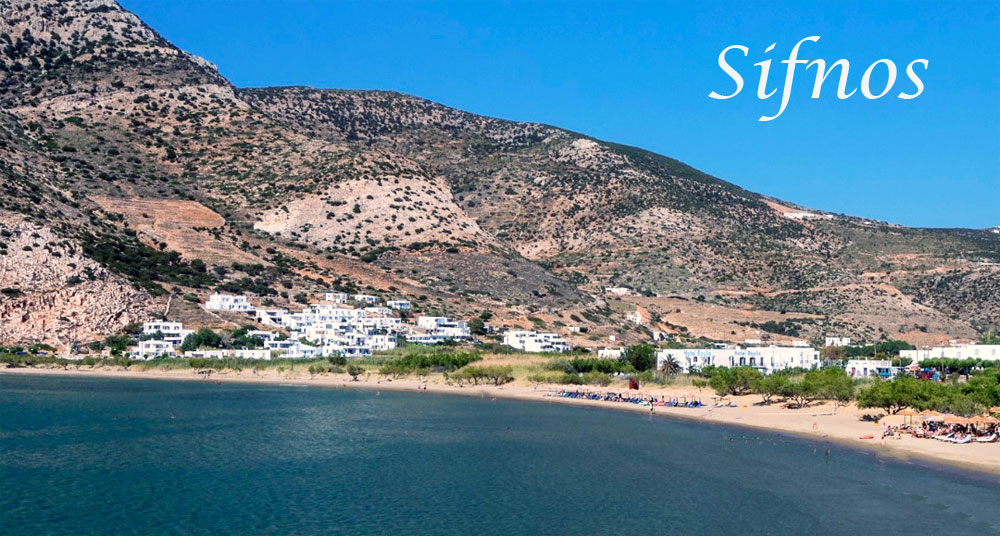
Information about Sifnos island Greece
Sifnos, one of the Cycladic Islands, lies 172 kilometres southeast of the mainland port of Piraeus. This island has a magnetic allure that draws Greek and international tourists alike, with thousands flocking to its shores during the peak season.
Sifnos stands out as one of the most captivating and characteristic islands within the Cyclades archipelago. Its rich history, lost in the depths of centuries, continues to influence every aspect of life on the island to this day.
Upon arriving at the unassuming port of Kamares, one might initially perceive Sifnos as a barren and rocky destination with little to offer. However, the true treasures of this island reveal themselves as you explore its charming villages, visit ancient sites, and wander through terraced hillsides fragrant with wild thyme and oregano. It is then that you begin to comprehend why Sifnos ranks as the most visited island in the western Cyclades.
 Access to Sifnos is exclusively by ferry or hydrofoil from the mainland or neighboring islands, as there is no airport on the island. Daily ferries connect Sifnos to Piraeus (a five-hour journey), Serifos, and Kythnos. Regular services also link the island with Kimolos, Folegandros, Sikinos, and Santorini. For a quicker journey, you can opt for a Flying Dolphin trip from Piraeus, Kythnos, Serifos, or Milos, albeit at a higher cost.
Sifnos boasts numerous highlights, including the medieval village of Kastro perched on the eastern cliffside, its exquisite cuisine, and the locally produced pottery exported throughout Greece. Along the southeastern coastline, you’ll find plenty of pristine beaches, while the southwestern bay offers a charming “untouristy” experience.
 With an excellent local bus service and an abundance of scenic trails winding through the countryside, you can explore all the island’s main attractions without the need for a car. Sifnos is adorned with elaborately decorated dovecotes, picturesque olive and almond groves, ancient monasteries, and an astonishing 365 chapels, one for each day of the year.
It is an island where the untamed beauty of nature harmoniously coexists with human craftsmanship. It boasts white churches, enchanting chapels, and grand monasteries. Sifnos also houses some of the most picturesque and traditional villages within the Cyclades.
The archaeological sites in Sifnos bear tangible evidence of its illustrious past. Archaeological excavations on the island reveal an important culture dating back to the Proto-Cycladic period. Sifnos carries the imprints of its history deep within its core, with traces that unveil the island’s story spanning countless centuries.
Among the island’s attractions, the settlement of Kastro stands as one of the most significant. Its medieval ambiance, narrow winding streets, and centuries-old history are truly captivating. Furthermore, the four Mycenaean citadels scattered across the island, with Agios Andreas being the most notable, serve as testament to Sifnos’ enduring history within the Cycladic archipelago.
History
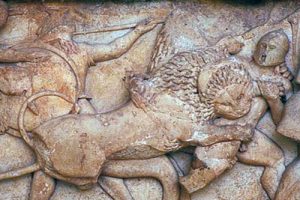 Sifnos was once the richest of all the Cycladic Islands, boasting huge reserves of gold, silver, aluminium and other precious metals. According to mythology the island takes its name from the son of the great Attican hero Sounios. But some historians believe the name comes from the Greek word for “empty” which is how the island was left after its inhabitants incurred the wrath of the god Apollo.
Legend has it that the islanders sent an annual gift of a golden egg to the god’s sanctuary at Delphi but one year they tried to get away with donating a gold-plated stone. Apollo retaliated by flooding the gold mines and leaving the island destitute.
Other names were Akhis probably from its pointed and triangular shape and Merope probably when the Minoans dominated the island and Merope was called the granddaughter of Minos daughter of Ariadne and Oenopion. It is also referred to as Sifanos or Sifando. Later it was inhabited by Minoans and therefore it was called Minos, while the Ionians followed around 1,130-1,120 BC. The Ionians had Sifnos as their leader, from which the name of the island comes.
Geography
Sifnos is a mountainous island with hills and small fertile valleys, with olive trees. Its natural landscape is mainly characterized by bushy vegetation without showing any “tall” forests. So the trees that dominate the landscape are ropes and a species of small cedar, which is protected. Its highest peak is located in the central part of the island and is that of Prophet Ilias with an altitude of 680 m. Followed by Agios Simeon, Prophet Ilias Troullakiou and Agios Andreas with altitudes of 490 m, 465 m and 425 m. respectively.
The Livadas stream originates from the central part of the island, which is 5.5 km long and flows into the Kamara bay. Another stream runs through the island in a length of 3 kilometers. These are the Erkeias that flow into the bay of Seralia Kastro. Around Sifnos there are rocky coasts, pebble beaches and golden sands. There are no other smaller islands around Sifnos, except for the uninhabited islet of Kitriani, in the southern part, near Cape Kontos.
Beaches
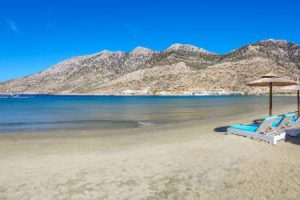 The best beaches of the island are located right and left of Chrysopigi. When you go down to Chrysopigi, it has three options for bathing. One is on the left the Akopofto, on the sandy beach where the taverns are, with comfortable parking. The second is on the rocks around the church. And the third is to the right of the church with stones and pebbles.
Platys Gialos for those who want the sunbed. It is the most organized beach of the island and accommodates all the good people.
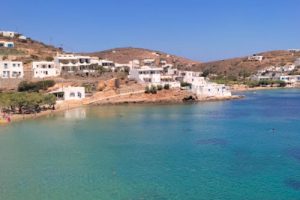 For isolation and bathing in Glyfo. One of the most beautiful beaches of the island. Park the car or take the bus to Faros and follow the path to Glyfos. It will be you, your company, the sandy beach and the tamarisk trees will shade you. Make sure you have water and everything else you want beforehand because you won’t find anything there. .
On the beach in Kamares, despite the fact that it is the beach opposite the port, it is very clean and the sand beach is quite long. Lying on the sand and watching the traffic in the harbor opposite is excellent. And if you’re looking for something more in terms of entertainment, you’ll hear music and see plenty of people partying at the two beach bars on the beach
What to do
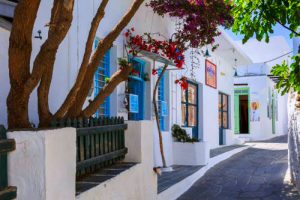 Apollonia is one of the island’s most beautiful villages with winding back streets filled with pottery and jewellery shops, charming houses with flower filled balconies and some excellent tavernas. Pay a visit to the Museum of Popular Arts and Folklore in the main plaza, Plateia Iroon, where you can see an interesting selection of traditional costumes, weapons, textiles, lace and cooking implements.
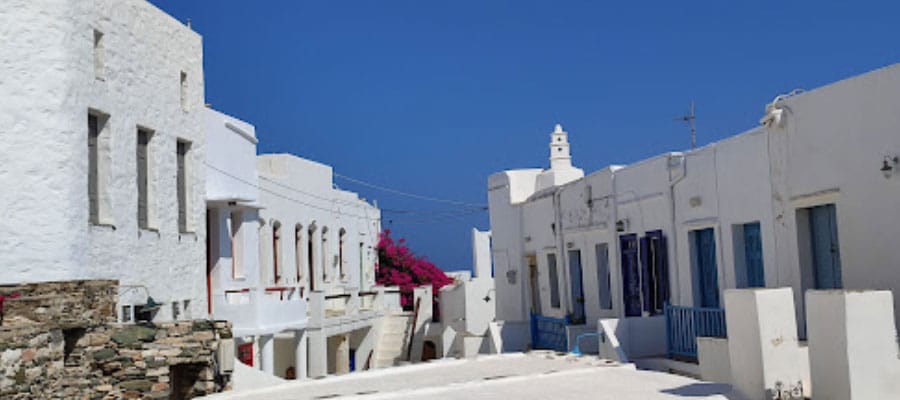
Visit the island’s ancient capital Kastro, either by bus or on foot, three kilometres from Apollonia. It’s a pleasant downhill walk of just over half an hour to reach this delightful town which has retained much of its original medieval character. The town stands on a rocky outcrop with an almost sheer drop to the sea on three sides.
The fortress like walls, formed by the backs of the houses, were originally designed to protect against the marauding pirates who once plagued these waters. These kastros (or castles) were typical of the pirate-safe towns built by the Venetians in the 14th and 15th centuries and you can see examples on several of the Cycladic islands. Visit the town’s archaeological museum to see a range of pottery, sculpture and other items found on the island, many dating back as far as the Archaic Period several centuries BC.
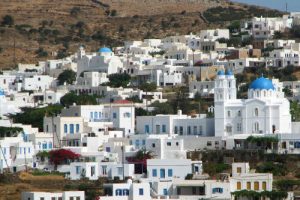 The village of Artemonas is a 10-minute walk north of Apollonia and has wonderful views, impressive Venetian mansions and the 17th century church of Agios Georgios. The church of Panagia Konchi was built on the site of an ancient temple of Artemis which gave its name to the village.
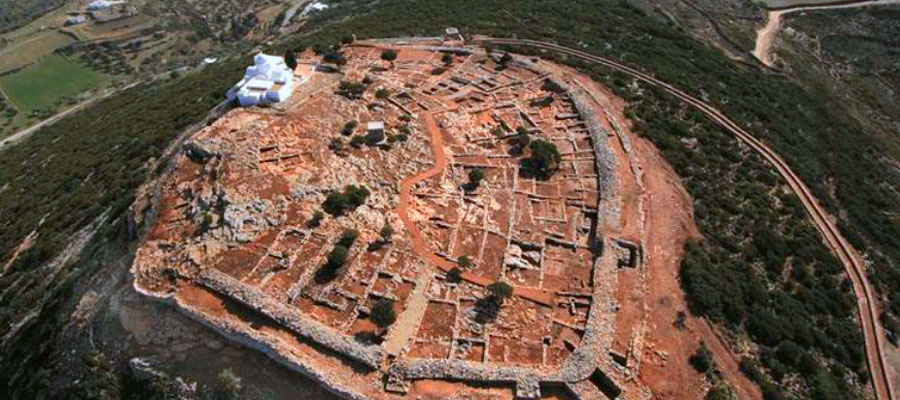
Interesting walking trails include a hike up to the hilltop church of Agios Andreas. The path starts about two kilometres south of Apollonia. At the top you’ll find the ruins of an ancient acropolis and stunning views of the neighbouring islands of Syros, Paros, Ios, Folegandros and Sikinos.
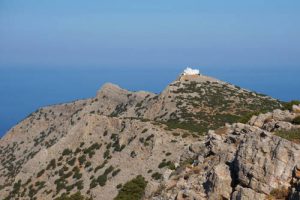 If you’re feeling fit, set off from Apollonia to the 12th century walled monastery of Profitis Ilias at the summit of the island’s highest mountain. Allow about three hours for the round trip which takes you through a stunningly beautiful valley in the centre of the island. The monastery has a lovely chapel and an interior courtyard lined with the monks’ cells.
Another impressive monastery worth visiting (and more easily accessed) is the 17th century Panagia Chrysopigi, perched on a rocky islet off the south east coast of the island. The monastery was built to house a miraculous icon of the Virgin Mary, found nearby in the sea by local fishermen. It’s connected to the mainland via a bridge and until recently its monastic cells were used as tourist accommodation.
What to see
The Kastro
Kastro is the old capital of Sifnos. It has been continuously inhabited since prehistoric times (first settlement on the hill in the 3rd millennium BC) until today. This is the ancient “Asti” mentioned by Herodotus and which flourished in the 6th BC. c., with a Rectory, a large temple and theater of Dionysos and luxurious public buildings made of white Parian marble (“white-grey market”). At the top of the hill we find the ruins of the ancient acropolis of Kastro (6th century BC), with a wall made of Sifnai marble, the only marble wall of this era in the Cyclades that has survived to this day. The ancient acropolis, the ancient columns embedded in the newer buildings, the Roman sarcophagi that we find in the alleys, the six “loggias” (portal gates through which we enter the settlement), the 16th and 17th century churches. with the decorated floors etc. make the entire settlement of the Castle an open museum.
Mycaenean Acropolis of Agios Andreas
On the hill of Agios Andreas Sifnos there is an important ancient acropolis. Two main residential phases are distinguished, the prehistoric one, and the historical ones, with . The first dates back to the Late Bronze Age, identifying with the Mycenaean period. According to the data so far, it seems to begin at least during the Late Helladic period (second half of the 13th century BC), with the establishment of a strongly fortified citadel. Undoubtedly, it was the cultural center of the island, flourishing throughout the period, the end of which coincides with its prehistoric abandonment. It was inhabited again in the Late Geometric period (second half of the 8th century BC) and flourished during the Archaic period (7th-6th century BC).
At the site is the Archaeological Museum of Agios Andreas, the newest and most modern museum of the island. Various selected findings from the excavations of the area are exhibited here as well as rich printed and electronic supervisory material for both the Mycaenean Acropolis of St. Andreas as well as for the rest of the island from prehistoric times to the last antiquity.
The White Tower
During the period of the island’s heyday (around the 6th century BC) and due to the wealth from the mining profits, the Sifnians began to build a network of towers throughout the island. Initially near the mines and later on the rest of the island, in cultivated areas and in strategic locations (tops of hills and slopes). These fortified and defensive constructions served both as lookouts and outposts that ensured communication inside and outside the island and as shelters for the rural population in sudden pirate raids. All the towers of the island were round. They communicated with each other and with the ancient citadels with mirror or smoke signals. Today the archaeological service has recorded 77 ancient towers in Sifnos, i.e. more than one tower per square kilometer. Several of them are located in remote places and are more difficult to reach, but there are also several that are more easily accessible. Of those that have been preserved at a fairly high height and are more accessible, the White Tower at Pantokrator (6th century BC), the Black Tower at Exampela (5th century BC) and the Tower at Kade on the road stand out. for Vathi (4th century BC).
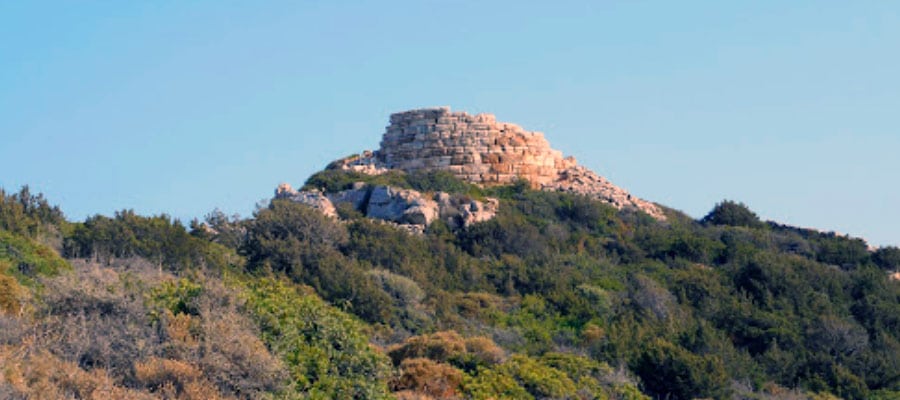
Archaeological Museum of Sifnos
The building was constructed by the Archaeological Service in the 1970s on a plot of land donated by Sifni’s professor G. Maridakis and is housed in a two-story building inside the village. It was restored by the Ministry of Culture in the early 1980s and has been operating normally since 1986. Its collections include finds from various places on the island such as: Sculptures (tombstones, statues, architectural members, etc.) from the archaic to the Roman era (6th century BC – 1st century BC) , ceramics from the Castle from the Geometric to the Hellenistic era (8th century BC – 2nd century BC), and coins. Among its most important exhibits are the flower-engraved epitaph of a marble tombstone (4th century BC), the head of a marble female statue (4th century BC), the head of a kouros made of marble (middle of the 6th century BC ), the marble Ionic capital (6th century BC), the marble tombstone (Hellenistic times).
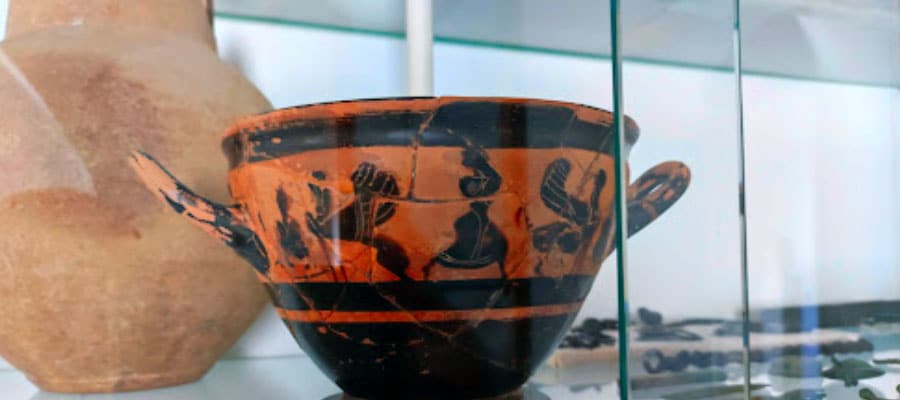
Ancient mines
The subsoil of Sifnos consists mainly of slates, gneisses and marbles, but it is also metal-bearing and contains silvery lead, copper, iron and zinc, an element that played a catalytic role in the development of the island since the prehistoric era, as the beginning of the exploitation of the ores deposits gave impetus to the general cultural evolution, being one of the main stages of the transition from the Stone Age to the Bronze Age. There are two arc-shaped ore-bearing zones: The one with silver-lead deposits is located in the northern part of the island and extends from northeast to southwest, from the locations of Agios Sostis, Agios Sylivestros, Voreini, Kapsalos and Xeroxylos. The second stretches from the area of Ai Giannis Faros to Apokofto and Aspro Pyrgos. In the peninsula of Ai Sosti, it was proved that the first mining activity for the production of silver and lead started at least from the beginning of the 3rd millennium BC. element that makes this particular mine the second oldest silver mine in the world.
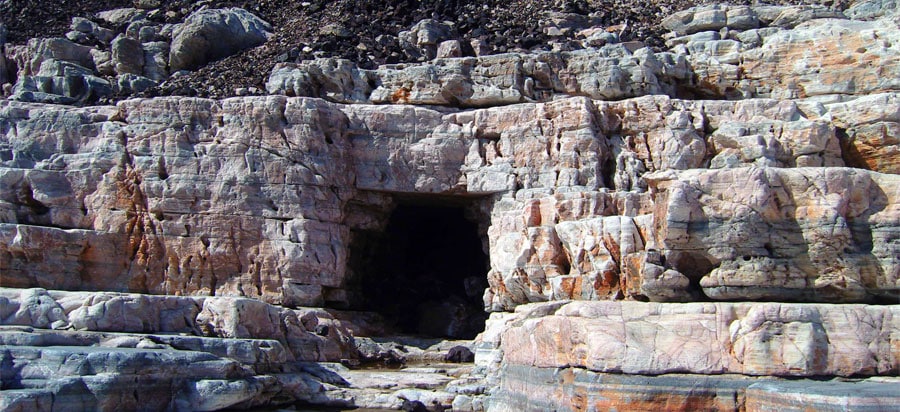
Folklore museum in Apollonia
It is housed in the central square in Apollonia. The the museum is the property of the Sifnian Association and includes exhibits from the traditional life of the island such as agricultural tools, household items, local clothing, etc. Its main exhibits are the collection of swords and rifles, the collection of old clothing, wood carvings and trunks, embroidery and laces, household items (including spoons & knives from Constantinople), agricultural utensils, items of wickerwork (such as the famous Sifnian umbrellas), beekeeping and pottery, busts of Sifnian personalities, Sifnos newspaper archives.
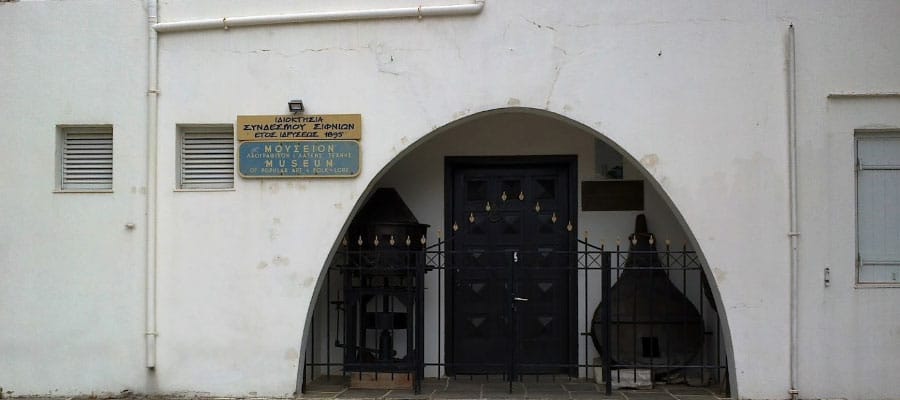
Local cuisine
One of the main dishes of the traditional cuisine of the island is the chickpea, which is baked in a clay for many hours, the night before, in an oven with branches. Chickpea meatballs, caper salad (dried capers cooked like a stew), kalasouna (vegetable pie with rice), manoura (yellow, hard, spicy cheese preserved in the rennet, i.e. the dregs of red wine), and depending on the season, are not missing from the table.
Chiroboskoi (wild greens), myzithra (fresh goat cheese with a slightly sour taste, ideal for a country salad), string beans with garlic, but also dried figs, loli (sweet made from red pumpkin), spoon sweets and liqueurs from fruits that thrive in Sifnos, as well as decoctions from the rich flora of the island, such as sage and chamomile.
Sifno’s sweets, such as aniseed cookies, butter biscuits, pot and baked almonds, pastries, loukoumia, patties, and spoon sweets, can be found in traditional bakeries and pastry shops.
Where to eat
In Herronisos, a small village at the northernmost tip of the island, our suggestion is to go for fish at the tavern of the same name on the pier. Herronisos has some of the nicest fish on the island. Choose a fish before you go for a swim because there is a small mess on its tables during the noisiest weeks of summer. In Faros and Glyfo, the two taverns Lichnos and Gorgona are very good and quite economical.
Even if you don’t swim in Fasolou, you must try Dimitris’ shrimp pasta. And you will also see quite a few boats and sailboats dropping anchor in this bay just for the food.
The Lebesis tavern with traditional Sifne food and tables overlooking the beach of Chrysopigi. One of the nicest and quietest places to eat, especially as evening falls and people start to leave the beach.
For those who like pizza Prago is on the way to Artemonas If you want a good bite while you are at the beach or a quick breakfast, pizza is a great option.
At Rabagas, a wonderful multipurpose hall that is located in Apollonia. With shops, galleries try the Moonfish restaurant for a more refined dinner.Mastelo, the traditional food of Sifnos, is worth trying. It is lamb or goat roasted on vines with local wine and plenty of dill.
For sweets, cakes and loukoumades try the pastry shop the three Blond Angels in Apollonia. One of the most classic pastry shops in Sifnos
Getting around
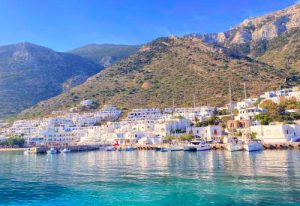 Sifnos is a small island and the best way to uncover its many treasures is on foot. Frequent buses connect the port of Kamares with the capital Apollonia and some services continue to the other main destinations on the island – Kastro, Artemonas, Vathy, Faros and Platys Yialos. Taxis hover around the port and the main square in Apollonia and you can also hire a water taxi in Kamares to take you anywhere around the coast.
But you may want to hire a car or moped for at least a day or two so you can explore all the main places of interest at your leisure without having to don your hiking boots or worry about bus timetables.
Cars and mopeds are available for hire in both Kamares and Apollonia. If you’re planning to hire a moped check that your travel insurance covers you for motorbike accidents before you take to the island’s rough tracks – because many policies don’t. And remember that wearing a helmet is compulsory in Greece if you’re riding anything over 49 cc although you wouldn’t think so to look at many of the local motorcyclists. In any event, it’s a sensible precaution because there have been numerous cases of inexperienced foreigners ending up in hospital after coming a cropper on the hazardous roads of the Greek islands.
With the benefit of your own set of wheels you’ll be able to enjoy the bustling beach scene of Platys Yialos and visit the quieter fishing villas of Vathy on the other side of the island (a short drive by car but a walk of about an hour and a half). Vathy could only be accessed on foot or by boat until a road was built from Apollonia in 1997.
Spend some time exploring Apollonia’s winding back streets filled with jewellery and pottery shops, flower-bedecked balconies and excellent tavernas. Drive three kilometres east to the ancient capital Kastro where the backs of medieval houses form a seaward defence wall (originally designed to guard against the marauding pirates who once plagued these waters).
The village of Artemonas is a short drive north of Apollonia and has wonderful views, impressive Venetian mansions and the 17th century church of Agios Georgios which houses some fine religious icons. From here you can drive out to Heronissos – an isolated hamlet at the north western tip of the island. Swim in the bay, maybe stop for lunch at one of the local tavernas and do a spot of souvenir shopping in the ceramic shops.
Drive south east of Apollonia to the small, friendly fishing hamlet at Faros where you’ll find some good beaches and tavernas without hordes of summer tourists. Visit the Panagia Chrysopigi Monastery, perched on an islet south of Faros. Here you can dive off the point, swim in small rocky coves or sunbathe on the beautiful tree-lined beach of Apokofto, just beyond the monastery.
Villages
Kastro
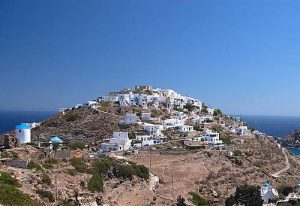 Kastro is located on the eastern side of Sifnos, and is exactly what the word says, a fortress. It was the ancient capital of Sifnos during the ancient, medieval and modern periods until 1836.
Kastro is one of the most picturesque, most beautiful and the most important of the island’s settlements from an archaeological point of view. This is the ancient “city” mentioned by Herodotus and which flourished in the 6th BC. century, with a temple and theater of Dionysos and luxurious marble public buildings.
It has been continuously inhabited since prehistoric times (first settlement on the hill in the 3rd millennium BC) until today. The name of the village comes from the “castle” formed by its buildings. The settlement has an ellipsoidal shape, because it follows the morphology of the terrain, has a defensive character and maintains unchanged its medieval (Venetian) fortified building form.
Apollonia
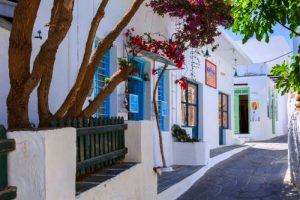 Apollonia is located in the center of Sifnos and is built amphitheatrically on three hills. In Apollonia you will find bank branches, the medical center as well as some private surgeries, the post office, pharmacies (especially in the summer months they stay open until late at night), travel agencies and gas stations.4
Buses connecting the settlements of Sifnos also stop in Apollonia.
In Heroes Square is the folklore museum of Sifnos, which exhibits objects from the traditional life of Sifnos. From here begins the path that connects Apollonia with Artemonas.
Artemonas
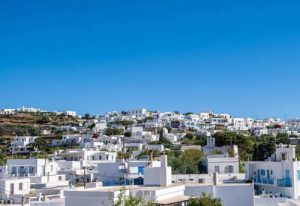 Artemonas is one of the largest settlements of Sifnos and a large part of the population of Sifnos resides here. It is built amphitheatrically and is located north of Apollonia.
At the top of the hill are two restored windmills. From this position it really “opens your eyes” as it has a view of the Aegean, the surrounding islands and the central settlements of Sifnos.
Walking along the central paved street, you will come across Panagia the Kochi, which is said to have been built on the ruins of an ancient cult center of Artemis.
On the same street are some of the most beautiful mansions of Sifnos, with large tree-filled gardens. In its alleys there are restaurants with traditional Sifnian flavors, small shops, sweet shops, traditional pastry workshops, cafes, bakeries, etc.
Kamares
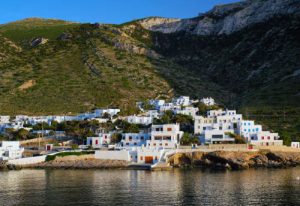 Kamares is the largest coastal settlement and the port of Sifnos.In the main shopping street of Kamares there are restaurants, with traditional Sifne flavors and more, cafes, mini markets, rental cars, ceramic shops, ATMs, the local port authority station and travel agencies.
Above the bay of Kamares, at the top of the mountain, is the monastery of Agios Simeon, which you can reach by following the road that continues from Agia Marina.
Other villages of Sifnos are Herronisos, Ano Petali, Agios Loukas, Katavati, Exampela, Kato Petali, Vathy, Platys Gialos, Chrysopigi and Faros
Entertainment and nightlife
In almost all the settlements of Sifnos there are cafes and bars. The center of entertainment is in Apollonia, where the night life of Sifnos is concentrated here, in the now known “Fun Strait”. T
here are restaurants, taverns, sweet shops, bars, traditional cafes with Greek and foreign music, as well as entertainment centers where the party lasts until the early hours of the morning!
For more relaxed drinks, Kamares, Faros, Vathi, Kastro, Artemonas, Platys Gialos are offered. You can combine your night out with a walk to the shops, which are present in all the settlements of Sifnos.
Where to stay
Sifnos offers a memorable stay that beautifully melds with its natural and cultural landscapes. The island’s accommodations not only provide restful havens but also serve as gateways to the rich tapestry of experiences that Sifnos unfurls. Here, every sunrise witnessed from a balcony, every homemade breakfast savored, and every sunset enjoyed by the pool becomes an integral part of the Sifnian experiance. Sifnos, characterized by its golden beaches, whitewashed chapels, and labyrinthine alleys, is also renowned for its diverse range of accommodations that cater to every traveler’s desires.
How to get to there
By Ferry
Throughout the year, there are regular ferry routes from the port of Piraeus to the port of Sifnos, Kamares. During the summer season, the routes increase to serve the travelers while Sifnos is also connected by ferry to Milos, Serifos, Kimolos, Kythnos, Andros, Tinos, Sikinos, Paros, Syros, Ios , Folegandros, Santorini and in general most of the Cyclades.
The Piraeus-Sifnos ferry line is also served by high-speed ships, reducing the journey time by approximately 2 to 3 hours.
By conventional ferry from the port of Piraeus, you need about 5 to 6 hours to reach the picturesque port of Kamares.
By high-speed ferry from the port of Piraeus, you need about 2.5 to 3 hours to disembark on the island . The “fast” ferries serving the access to Sifnos operate in the period March-November
The duration of the journey with the conventional ferries is about five hours and with the speedboats about three hours. There is also a more sparse connection with other islands of the Cyclades (Paros, Syros, Serifos, Santorini, Folegandros etc.), while via Santorini and Milos it is also connected to Crete.
By Air
The island lacks of an airport. There is of course the option of traveling to the nearest airports of Milos, Paros or Syros and from there take the ferry to Sifnos, there is a heliport though , which operates in emergencies.