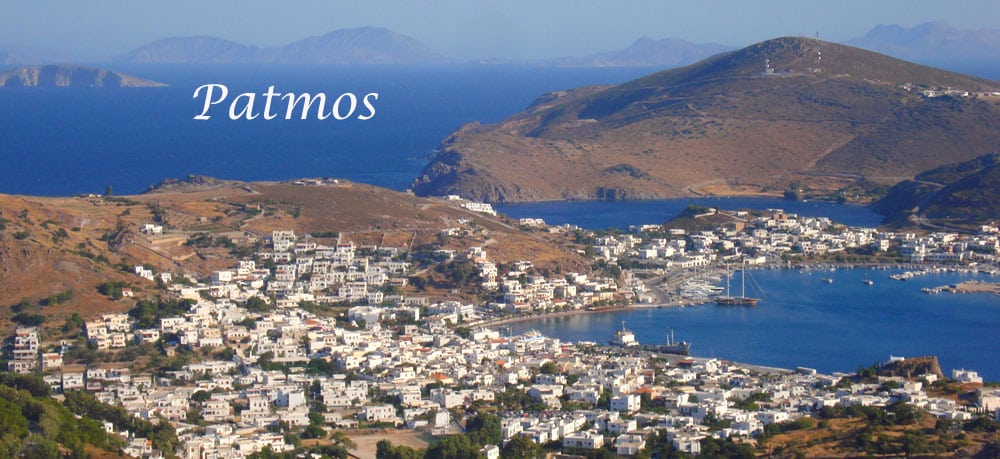
Information about the island of Patmos
 Patmos is one of the Greek Dodecanese Islands located in the Aegean Sea 302 kilometres south east of the mainland port of Piraeus. Its greatest claim to fame is that it was the place of exile for St John the apostle who wrote the final book of the bible in an island cave which is still one of Christianity’s most holy pilgrimage sites. The island of the Apocalypse and the Jerusalem of the Aegean, as Patmos is called worldwide , is one of the most important religious and atmospheric destinations, but without missing the cosmopolitan air of an Aegean island and the cultural tradition.
Its varied lacy coastline, ten times larger than that of Greece in relation to its area, creates unique coves and beaches, some pebbly, others with sand or with rocks and caves, others calm and others more secular, which make Patmos in the Dodecanese at the same time an ideal destination of peace, tranquility, picturesqueness, mysticism and recreation, which embraces every visitor with its aura.
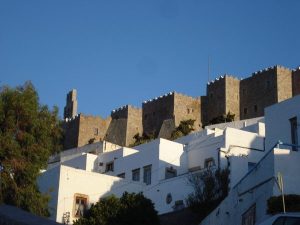 The medieval town of Chora, with the Monastery of St John’s the Theologian that dominates like a crown on its top, the picturesque and multi-paved alleys and the stately houses that surround the Monastery, as well as the special architecture of the settlements offer its visitors the unique opportunity to get to know a world that is ancient and modern at the same time, which combines tranquility with the unpretentious cosmopolitan element and culture.
The cave and nearby Monastery of St John are without doubt the island’s star attractions, bringing thousands of faithful pilgrims and not so faithful tourists to Patmos each year. But the island also boasts some fine, unspoilt beaches and remains mercifully unscathed by the worst excesses of mass tourism, partly because of its religious significance as the Jerusalem of the Aegean.
You can reach the island by ferry, hydrofoil or catamaran as it’s a regular stopping point for boats on the main north-south route between Piraeus and Rhodes. The Greek mainland is a gruelling 10-12 hours by ferry so unless you’re island-hopping in the vicinity you might prefer to fly into nearby Leros, Kos or Samos then catch a boat to Patmos.
Day-trippers to the island, who come here primarily to visit the monastery, outnumber those who make this their main holiday destination. The package industry hasn’t yet arrived here in force so if you decide to stay a while, you’ll find Patmos to be a relatively unspoilt island with some magnificent scenery, secluded beaches and plenty of excellent eateries serving first class traditional fare.
You’ll arrive at the bustling port of Skala on the east coast – a glitzy concoction of waterfront cafes and souvenir shops catering for the yachties and cruise liner passengers who swarm ashore here in high season.
 Most of the accommodation on the island is centred in Skala and the beach resorts of Grikou to the south and Kambos to the north. Both these resorts are well served with water sports and tourist facilities.
Explore the coastline beyond these main resort areas and you’ll find plenty of quiet beaches, some of which can be reached by excursion boat.
A visit to the Grotto of St John the Divine and the magnificent 11th century monastery dedicated to him will no doubt be top of your agenda. The saint was banished here in AD 95 by the Roman emperor Domitian and lived in the cave where a series of divine revelations led him to dictate the final book of the New Testament “The Apocalypsis” to one of his disciples.
The monastery, one of the most important in Greece, was founded in 1088 by an abbot, the Blessed Christodoulos, and was built as an impregnable castle to withstand pirate raids. It houses priceless religious treasures and attracts pilgrims from all Greece and beyond, especially during the Easter Week celebrations when the current abbot washes the feet of 12 monks (re-enacting the Last Supper when Jesus washed the feet of his 12 apostles).
Geography
Patmos, one of the smallest inhabited islands in the Aegean, is located south of Samos, southeast of Ikaria and northwest of Leros and 25 miles from the coast of Turkey. The island, whose shape refers to the sea hippocampus, has a maximum length of 16 km. and a maximum width of 9.6 km. and its coastline is 62.4 km long.
It consists of three land masses joined by two isthmuses, with the highest point being the hill of Prophet Ilias (269m). A volcanic island, its outline presents an impressive sequence of beaches, bays, harbors, bays, headlands and oddly shaped rocks, while the interior is characterized by a sharp relief with sharp elevations at both ends, rocky hills, lower levels, valleys and small meadows, often at the mouths of bays.
History
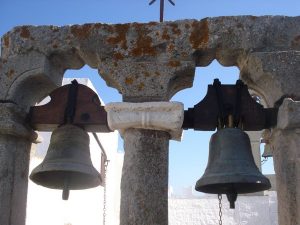 The first name of the island is considered to have been “Letois”, from the goddess Artemis, daughter of Leto, as it is believed that Patmos was born thanks to her. The second version claims that its name comes from Mount Latmos in Asia Minor, where the goddess Artemis was especially worshipped, from where the first inhabitants of the island came, carrying the worship of Artemis. Orestes, hunted by the Erinyes for killing his mother Clytemnestra, passing with the Argives found refuge in Patmos.
In prehistoric times it was inhabited by the Carians, later by the Dorians and later by the Ionians! In the place of the current monastery of Saint John the Theologian, there was an ancient Greek temple of Patmia Artemis, as evidenced by relevant inscriptions and the surviving columns.
During the Byzantine period (and mainly during the 7th – 8th century) Arab raids became the cause of desolation of the island. Many monuments were destroyed, while the inhabitants of the island were kidnapped and sold as slaves.
The colonization of Patmos will start again in the 11th century, specifically in 1088 AD. where Saint Christodoulos the Lateran founded the holy Monastery of Saint John the Theologian, after the Byzantine emperor Alexios I Komnenos granted him the entire island.
The artisans who came to build the Monastery first settled in the Kampos area, north of the island and then moved around the walls of the Monastery to protect themselves from pirate raids, thus creating the first residential core of Chora.
Chora of Patmos
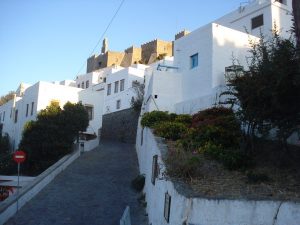 Chora is a maze of twisting medieval alleyways circling the imposing fortified monastery of St John which sits above Skala and dominates the whole island of Patmos.
Strangely spooky thanks to an absence of colour, everywhere is whitewashed with doors painted grey or black and few trees, flowers or natural vegetation.
The traffic-free alleys are narrow, often a little claustrophobic and wrap around the steep hill in a chaotic maze – a reminder of when they confused pirate raiders – it is easy to get hopelessly lost.
Terrific panormas of the whole island are on offer from small cafes beneath the monastery walls while more romantic tavernas lie hidden away in tiny squares.
The small, but impressive, monastery of St John the Divine tops the Chora (see Patmos Sights) and has very fine frescoes and icons. The trick is to avoid the cruise ships crowds when the place is crawling.
Skala the port of Patmos
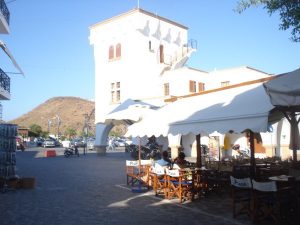 The main Patmos port at Skala has a utilitarian air that belies the rest of the island. The deep inlet accommodates the biggest cruise liners as well as catamarans, ferries and fishing boats.
Ferry arrivals are greeted with a swathe of concrete opposite the main Skala square which is laid out with cafe tables and caged birds twittering beneath large white parasols.
Beyond the square, narrow streets fan out in all directions, lined with small shops touting everything from tourist trinkets to designer goods all aimed at cruise ship passengers on their way to the Chora and the holy cave of St John.
Racks of clothes, sunglasses and craftwork join cafe chairs as if by magic whenever a cruise liner docks; the empty white alleys turn into bustling shopping arcades in moments.
A short walk inland reveals a modest maze of whitewashed houses spreading up the hill. They look pretty from afar but close too they are little more than concrete cubes.
A narrow stretch of sharp sand lines the shore to the north of the port enlivened by cafe tables set out beneath shady tamarisks but the small beach is backed by a busy and noisy main road.
Local cuisine
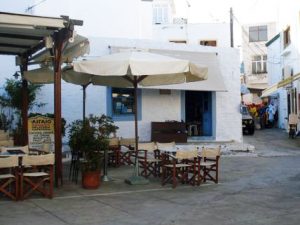 The culinary wealth of Patmos is inexhaustible, including a wide variety of local products, recipes and dishes, which can give each visitor another unique experience.
Local vegetables, fruits, the well-known local Patmos cheese pies (tart-shaped) filled with local cheeses, stuffed squids, flower water, fragrant bread and the famous sweet pouch with honey or powdered sugar, are just a few of the tasty delights that the Patmos has.
In the numerous tavernas and restaurants of the island, visitors have the opportunity to try both home-made traditional recipes of the island, as well as fresh fish and handmade sweets, while in the island’s patisseries they can get some of these tasty treasures.
What to do
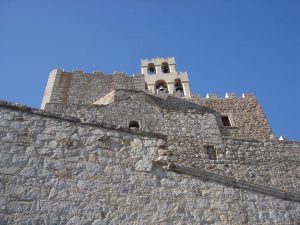 The main attractions of Patmos are undoubtedly the Monastery of St John and the cave of the Apocalypde which together represent the sole reason why many visitors come to the island. These two holy places of pilgrimage attract tourists and the Christian faithful in their droves, especially during the island’s Easter Week celebrations which are among the most important in Greece.
You can take a bus up to the monastery, which crowns the island’s hill top capital Hora to the south of the port, or walk up the Byzantine cobbled path leading from Skala to the so-called Cave of the Apocalypse and onto the monastery. It’s a steep and challenging hike of about 45 minutes so you might want to take a bus or taxi there and enjoy the scenic but more leisurely walk back.
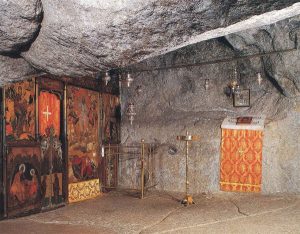 The cave is about half way along the path, housed within the 11th century Church of Agia Anna. Even if you’re not one of the faithful for whom this is one of the holiest shrines of the Christian world, you can’t help but be stirred by the mysticism of this ancient site where Jesus’ apostle wrote the closing chapters of the bible.
The fortified monastery, with its towers and buttresses dominating the pretty whitewashed village of Hora, was built in honour of the saint in 1088. A soldier-monk from Asia Minor, Ioannis “The Blessed” Christodoulos, founded the monastery after being granted title of Patmos by the Byzantine emperor Alexios Komnenos. The island became an independent monastic state and was ruled by monks for the next six centuries.
The castle-like monastery’s fabulous collection of priceless treasures includes the emperor’s 11th century gold-sealed edict handing control of the island to Christodoulos. The tomb of Christodoulos, important 12th century frescoes and a dazzling array of jewels, religious icons and silverware are contained within the monastery walls.
If you visit at Easter you’ll be able to join the masses who converge on Hora to watch the current abbot publicly wash the feet of 12 monks in a re-enactment of the Last Supper when Jesus washed the feet of his apostles.
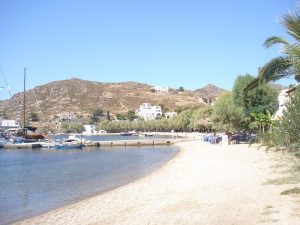 In the unlikely event that you tire of the beaches of Patmos, there are plenty of boat excursions to be enjoyed around the island and to neighbouring islands.
Little Lipsi, 12 kilometres east of Patmos, is a green and magical island well worth a day trip for its uncrowded beaches, good tavernas and lack of tourist paraphernalia.
At Arki, five kilometres north of Lipsi, you can swim in the beautiful turquoise waters of the Blue Lagoon off the south east tip of the island. Or enjoy a day on the superb tree-lined sandy beach on the tiny islet of Marathi where two tavernas serve lunches to day trippers from Patmos.
Where to stay
Patmos island has a good range of holiday accommodation, from high-end hotels to cheap rooms. The popularity of the island for those visiting the Cave of St John means the main port of Skala has plenty of hotels and rooms.
Most rooms to rent are found in Skala, the main south-east coast resort of Grikos and in Kambos, to the north. Finding rooms in the hilltop capital of Chora can be tricky in the summer months or during the holy island’s Easter week celebrations.
Plenty of room owners meet passengers off the ferries as they arrive in Skala but don’t commit yourself until you’ve seen the rooms. There are often good budget options on offer but some accommodatin can be isolated.
Backpackers usually head for the Stefanos Campsite at Meloi beach, about two kilometres north-east of Skala, which has an excellent taverna, laundry, fridges and grill facilities. You can take your own tent or rent one and it has a minibus service to the port.
Both Kambos, north along the coast from Skala, and Grikos, to the south, have a good supply of hotels, rooms and self-catering apartments.
Weather on Patmos
Patmos has a mild Mediterranean climate with some 3,000 hours of sunshine a year and very little rainfall over the summer. Rain falls on average for about 80 days each year, mostly between November and February.
The holiday season starts in April-May when temperatures rise to the mid 20s. In summer months the average temperatures reach day-time highs of 30°C and night lows of 23°C. In winter months the average daytime highs on Patmos are 14°C and night lows stand at 9°C.
How to move around
Patmos is a small island and most beaches are walkable from the capital port at Skala. Good roads link Skala to all the main beaches and there are short dirt tracks to others. The only beach without any road access is at Psili Ammos which is reached by boat, or along a hill track.
A road to the north leads throu Meloi to Kambos village and beach then around the coast to Linginos when it peters out. A branch west from Kambos heads to the east coast at Levkes.
A south road heads up to the Chora and down to the beach resort of Grikos, then to the narrow neck at Stavros where it ends abruptly.
Buses
A daily bus service operates from the harbour entrance at Skala, near the police station, with 10 buses a day to Chora, a journey time of 10 minutes. Eight buses a day continue on to the beach resort at Grikos, another 10 minutes to the south. There are also four buses daily to Kambos beach in the north that takes about 15 minutes.
Patmos bus schedules are usually posted in the central square in Skala, at the main Skala bus stop and at the tourist office.
Taxis
The taxi stand in at the entrance to Skala harbour but they get snapped up quickly when ferries and cruise boats arrive. Visitors won’t have long to wait on such a small island. Check the fare before getting in; Patmos taxi drivers tend to charge extra when they can – the consequence of so much traffic from visiting cruise ships.
Several car rental firms operate in in Skala and petrol stations usually open 7am-9pm weekdays and 7am- 3pm on Saturday. There are petrol stations at Skala, Chora, Grikos and Kambos.
How to get to Patmos
By ferry
Patmos can be reached on Ferry from the Athens port of Piraeus, from neighbouring Samos to the north, which has an international airport, or on a fast ferry the popular holiday island of Kos to the south.
Daily ferry sailings leave from Gate E1 gate at Piraeus, with routes to the Dodecanese operated by Blue Star Ferries and ANEK Lineswith journey times of 7-10 hours depending on the ferry type and the route taken.
Dodekanisos Seaways operates two high speed catamarans from Rhodes that also call at Lipsi, Leros, Kalymnos, Kos and Rhodes with journey times from Rhodes of five hours and from Kos just over two hours.
With cheap flight airlines now operating to Kos this route makes for a reliable way to reach Patmos, although it may require an overnight stop on Kos to catch the morning catamaran. Blue Star also operate ferries on this route with a crossing from Kos taking three hours.
A flight to Samos and a hydrofoil to Patmos used to be an option until the service suspended. Getting a boat from Samos can now prove a problem. ITSA Travel on Samos run daily trips to Patmos in the summer.
ANEK runs the ferryboats Nissos Kalymnos and Kalymnos Star between Kos and Samos calling at Leros, Patmos, Astpalea, Lipsi, Agathoisi and Pythagorion and can be contacted on their website here.
There are a number of small ferry companies operating in the region. The Patmos Star runs daily services between Patmos, Leros and Lipsi. The boat usually leaves Patmos and 9am, Lipsi at 10am and arriving on Leros at 2pm and returning to Patmos in the afternoon. It opens the possibility of a flight from Athens to Leros before catching the ferry to Patmos. Sailing time can change but Astoria Travel on Patmos may help with latest sailing times
Caiques from Skala visit all the main beaches in the summer months. There are often daily cruises on offer to Samos, Ikaria, Fourni, Lipsos and the surrounding islands of Marathi, Agathonisi, Aspronisi, Macronisi, and Tiganakia. Daily cruises also leave for beaches at Psili Amos and Lambi. in the high season.
By Air
Patmos has no airport and the nearest airports are on the neighbouring islands of Leros and Samos. Most visitors get a flight to Kos or Samos, then take a ferry to Patmos.
The nearest international airport is Samos (SMI) otherwise called Aristarchos Airport which is about three kilometres outside Pythagorion and 10 kilometers from the capital.
There are good ferry connections from Pythagorion and the summer ferry schedules (July-September) are usually posted in the port. If you have to stop overnight there is usually no problem with finding rooms as Pythagorion is a big holiday centre.
Flying to Kos International is also a reasonable option, although the island is considerably further away and it’s a two-three hour ferry journey. There are two ferry ports in Kos. Mastichari is only eight kilometres from Kos airport but ferry connections are few and it may mean changing boats at Pothia on Kalymnos.
There are more direct ferries from Kos Town, but this is 26 kilometres west of the airport and getting there will require catching a bus or taking a relatively expensive taxi ride.
Facts about Patmos |
Phone numbers |
| Size: 35 km2 | International code: 0030 |
| Population: about 2500 | Local code: 22470 |
| Cash machine: Yes | Health centre: 31211 |
| Internet cafe:Yes | Police:31303 |
| Highest Mountain:Profitis Elias, 269m | Coast guard: |
| Airport: No | Port Police: 31231 |
| Tour Operators: | Taxi:31225 |
| Price rate: Average | Tourist Information Office: |