Life, Campaigns and Legacy of Alexander III of Macedon
 Alexander III of Macedon, known as Alexander the Great, was a Macedonian king and one of the most important figures in world history.
Alexander was born on 20 or 21 July 356 BC in Pella, Macedonia. His father was King Philip II of Macedon and his mother was Olympias, daughter of King Neoptolemus of Epirus. From his father, Alexander inherited his keen perception, organizational skills and quickness of action. And from his mother, ambition, pride and strong will.
In his childhood, he was educated by the tutors Leonidas the Molossian and Lysimachus the Acarnane. At the age of 13, he became a student of Aristotle. The great philosopher educated him with Greek ideals and inspired in him admiration and love for the Greek spirit and culture. He always showed respect and gratitude to Aristotle. He said that he owed his father “his livelihood” and his teacher “his well-being”. He received important lessons in politics and strategy from his father. He was always with him when he discussed with foreign ambassadors and envoys. He followed him on campaigns, where he received lessons in military art. Thus, from a very early age he acquired political and military maturity.
At the age of 16, as a replacement for his father, who was absent on a campaign, he suppressed the rebellion of the Thracian tribe of the Maidens, while at the age of 18, at the Battle of Chaeronea (August 2, 338 BC) he was the commander of a military corps and distinguished himself for his martial virtues.
The ascension to the throne
At the age of 20, he became king of Macedonia, after the assassination of his father in 336 BC. From a very early age, he faced organized conspiracies against him, which he dismantled with lightning speed. With the same lightning speed and determination, he campaigned against the cities of Southern Greece, which, as soon as they learned of Philip’s death, rebelled.
However, as soon as they were informed of Alexander’s campaign against them, they hastened to declare their submission and, at a congress held in Corinth, they proclaimed him Hegemon of Greece, just like his father earlier, and commander-in-chief in the upcoming campaign against the Persians. Alexander, satisfied, returned to Macedonia. In order to free his kingdom from any danger, before he campaigned against the Persians, he campaigned against the barbarian tribes that lived north of Macedonia (335 BC). He defeated these tribes, reached the Danube and returned to Pella.
ndeterred, he began preparations for the great campaign against the Persians. However, he found himself in need of coming a second time to Southern Greece, where the Thebans and the Athenians had again rebelled. After suppressing the rebellion of the two cities, he returned to Macedonia and completed his preparations for the campaign against Persia
The campaign against Persia
 In 334, Alexander, at the head of about 30,000 infantry, 5,000 cavalry and 180 ships, crossed into Asia {see the army of Alexander the Great). With his proclamations and actions, he made it clear from the beginning that his intention was to live (and die) between history and legend – perhaps closer to legend. He presented his military operations as revenge for what the Greeks had suffered at the hands of the Persians, but also as a repetition of the brilliant feats the Achaeans had achieved against the Trojans. In addition to the Persian Wars and the Trojan War, he was inspired by the daring of the Myrians against the great king and by the undertaking of Agesilaus to liberate the Greeks of Asia. Alexander seemed to believe that the conflict with the Persian Empire had a long history, which defined and guided it. Moreover, that it would provide a way out of the problems of the Greek world and that it would confirm his leading position in practice. His army, moreover, included many thousands of hoplites from many Greek cities as well as mercenaries.
Crossing the Hellespont, Alexander followed the opposite course from that of Xerxes. Since the Persian king had failed to unite Asia with Europe, it remained for him to achieve the union of Europe with Asia. In a symbolic gesture, he offered a sacrifice at the tomb of Protesilaus, the Achaean who was killed first stepping on the soil of Troy, in order to open the way for the final victory. He then crowned the tomb of Achilles, while his close friend Hephaestus crowned the tomb of Patroclus. At his head, according to tradition, he always had, along with his textbook, the Iliad, corrected by the hand of his teacher Aristotle. It is obvious that he desired not only to triumph, but also to be glorified like Achilles. For this purpose, he included in his court the experienced historian Callisthenes, Aristotle’s nephew and collaborator. He also commissioned experts to compile daily reports (ἐphemerides) on the progress of his campaign.
The story of Alexander’s military achievements was also recounted by other writers, both contemporary and later. From an early age, history was enriched with numerous mythical elements, as required by the historiographical customs of the time and the insatiable reading public. Already in antiquity, the contradictions and disagreements were such that it was difficult to distinguish real events from fiction. In the 2nd century AD, this distinction was attempted by Arrian, a high-ranking official in the Roman administration with a good philosophical background. From the material at his disposal, he mainly selected the testimonies of two of Alexander’s comrades-in-arms, Aristobulus and Ptolemy, son of Lagos. (The latter had composed his narrative when he himself was now king.) Arrian’s work was considered so successful that it overshadowed all previous histories.
As Alexander marched his army into Asia, Antipater, an aristocrat and old comrade-in-arms of Philip, took over as general of Europe. His duties included the administration of Macedonia, the guarding of its borders, and the surveillance of the Greeks. There was no doubt that many cities, first and foremost Sparta and Athens, were waiting for the right opportunity to claim their freedom.
The Persians were not surprised by Alexander’s arrival. Since the time of Philip, they had been facing invaders on Persian soil. After all, the crossing of such a large number of men into Asia could not have gone unnoticed. However, they allowed the enemy to cross the Hellespont unmolested. In Persia, assembling a large army was always more time-consuming than in the Greek world. Moreover, choosing the right defensive strategy proved to be a difficult task.
The Persian generals who had undertaken to deal with the situation were many. Among them were relatives of the great king. The cavalry they assembled was numerically superior to that of Alexander – although the infantry may have been smaller. (As usual, the sources are not very reliable or consistent in their numerical data.) Many Greek mercenaries, many of them Athenians, also fought on the side of the Persians. Memnon the Rhodian also took part in the council of the Persian leaders.
Memnon was the right person to advise the Persians. He held a high position in the empire and was devoted to Darius. In addition, he was married to Barsine, daughter of the satrap Artabazus. He knew the Macedonians well, having served at the court of Philip. Two years earlier he had terrified the Macedonian army, which was fighting under the orders of the general Parmenion.
Realizing the new situation, he was of the opinion that the Persians should not confront Alexander head-on, but should retreat, setting fire to the fields from which such a large army could be supplied in enemy territory. His opinion was rejected, because the generals were not willing to destroy Persian land. They also considered it unworthy of them to avoid battle. So they lined up their forces on the banks of the Granicus River. Alexander’s army was soon found on the other bank.
Alexander prepared for battle, assigning the left wing to Parmenion and himself leading the best cavalry from the right. Instead of waiting for the right moment to cross the river, he unexpectedly and rashly launched the attack, with the enemies positioned in a higher and more advantageous position. The Persians, for their part, instead of blocking the crossing of the river with their infantry, preferred to defend themselves with their cavalry, which proved to be inferior to the circumstances and was defeated. Many Persian generals also fell on the battlefield. Untroubled now, Alexander turned his cavalry against the Greek mercenary infantry, who fought him bravely. He killed most of them and, those he captured, sent them to Macedonia to work as slaves in the harshest conditions.
To honor the dead Macedonians, Alexander ordered the erection of bronze statues of them, made by the sculptor Lysippus, the only one who had the right to sculpt his own busts. Three hundred Persian armor or shields he sent to Athens to be dedicated to the goddess. The spoils were accompanied by an inscription: “Alexander son of Philip and the Greeks, except the Lacedaemonians, from the barbarians who inhabit Asia [dedicated].” He wanted in this way to flatter the Greeks, and especially the Athenians, showing his contempt for the Spartans. But the Lacedaemonians probably took the aversion as discrimination. They alone of the Greeks had refused to submit.
After the battle on the Granicus River, Alexander experienced many more successes. Sardis, the old capital of Lydia, surrendered. Similarly, several Greek cities welcomed him as a liberator. They may not have been exempted from taxes, but they restored their democratic regimes – whatever meaning this political change had under the tutelage of a powerful army. Miletus, however, where Persian forces were concentrated, resisted and forced Alexander to conquer it with difficulty and force. Alexander also conquered Halicarnassus, with a difficult and bloody siege, and other cities, constructing siege engines. Considering that everything would now be decided on land, he disbanded his navy, which he could barely maintain anyway. However, he sought reinforcements from Macedonia, the Peloponnese and wherever else it was possible.
Behind the cities that resisted Alexander was often Memnon, whom Darius III had now appointed general of the war. Memnon always followed the same strategy. For him, it was not how many cities Alexander could conquer, but with what sacrifices his advance was made. Going on the counterattack, he recaptured Chios and Lesbos on behalf of Persia. Then he began to receive ambassadors from most of the Cycladic islands. The conditions were now suitable for the implementation of a tactic tried in the past.
With plenty of money at his disposal, Memnon was preparing to transfer the war to Greece, inciting as many as he could. However, he fell ill and died. The responsibility for the war thus passed back to the Persian generals, who decided to confront the invaders in open battle. Alexander’s delays gave them the impression that he was avoiding a clash with their main forces. After all, they had assembled a truly large and powerful army. The sources even speak of 600,000 men, an assumption that surpasses all imagination. (It is most likely that even Alexander never learned the real numerical strength of his opponents.)
When Memnon died, his wife Barsini fell into the hands of the Macedonians. From among the captives, Alexander chose her as his mistress, for her origin, her Greek education and her beauty. With the former wife of his great opponent, he thus had a son, the only one he managed to meet during his lifetime.
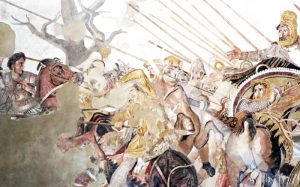
In 333, Darius chose to move against his enemies in person. Urgently putting an end to the invasion, he abandoned the open field, where he could deploy his numerous forces, and sought out Alexander in the relatively narrow passes of Issus. When the time came, he took up his position with his chariot in the center, as was prescribed for Persian kings. The Persian arrows that were fired were so dense that they intertwined with each other, while the mountains echoed with the shouts of the soldiers. The conflict was fierce and at first lopsided.
However, Alexander, who rushed, as he usually did, unexpectedly from the right, aimed at the great king himself. Although the Greek mercenaries fighting on the Persian side were achieving success, Darius, faced with the onslaught of the Macedonian cavalry, panicked and retreated. He abandoned his chariot, threw away his royal weapons and cloak, and rushed to safety on horseback. His departure caused confusion in the Persian army, and the disorderly retreat resulted in a massacre.
Abundant Persian gold and silver passed into the hands of the victors, while Darius’ mother, his beautiful sister and wife, his daughters, and the wives of his generals, who, according to custom, accompanied the army, were dishonored. When Alexander learned of the capture of Darius’ family, he treated the women with magnanimity and bestowed upon them as many royal honors as the circumstances of their captivity permitted – although Darius’ wife ultimately died pregnant.
Having achieved a crushing victory at Issus, Alexander rejected Darius’s compromise proposals, which would have given him a large part of his kingdom, and led his army towards Egypt, through Syria and Palestine. In his path he found the gates of most cities open and the inhabitants ready to surrender. The main resistance came from powerful Tyre, which decided to remain loyal to Darius. The city’s inhabitants hoped that its strong walls would protect them and, moreover, that they would give Darius the necessary time to gather a new and strong army. The siege of Tyre lasted almost seven months, during which each side demonstrated not only its zeal but also its resourcefulness.
To confront a city built on an island, with strong fortifications and a navy, Alexander ordered the construction of a large rampart, so that he could attack from the sea. He used siege towers, arrowheads and stone-throwing weapons that launched huge stones and strained the walls. The Tyrians, for their part, made use of catapults, pyrophores and all kinds of tricks. They threw red-hot sand at the besiegers that penetrated their armor and attacked them with hooks and iron grapples.
When the walls of Tyre were now half-collapsed, Alexander himself was placed at the head of soldiers who crossed into the city using a wooden bridge and captured it. During the siege, approximately 8,000 Tyrians and 400 Macedonians were killed. The reprisals for the losses and the delay were merciless. Those fighters who remained alive were killed. More than 2,000 young men were hanged along the coast, and thousands of civilians were freed. The now deserted city was handed over to new residents. Gaza was then besieged and conquered within two months. The fighters were all killed, while the women and children, as in Tyre, were enslaved. The road was now open to Egypt.
On his way from Tyre to Gaza, Alexander crossed Palestine with his army, but he did not bother to visit Jerusalem. Moreover, no Greek historian commented on the conquest of the small Jewish people. The Jews had had good relations with the Persians since the time of Cyrus and Darius I, but they were unable to resist Alexander. They evidently hoped that the new conqueror would tolerate, like the Persians, their religious peculiarities and that he would allow them to continue living according to their laws.
However, they were terribly impressed by the king’s momentum and the speed with which he conquered the Persian Empire. Their impressions were captured years later in the so-called prophecy of Daniel. Its author imagined Alexander as a goat with an impressive horn between its eyes, who came from the West and ran across the earth, without touching the ground. He imagined Darius as a ram with two horns. Enraged, the goat ran with all its might against the ram and crushed its horns. The ram did not have the strength to resist, and so the goat threw it to the ground and trampled it.
Indeed, Alexander’s domination in the East did not seem to change much in the habits of the Jews, nor of the other conquered peoples. However, no one could at that time foresee the consequences for the Jews of the transition from the Persian world, which spoke Aramaic, to the new world, which was to speak Greek.
The Persian satrap surrendered Egypt in 331 without a fight. He did not have a sufficient army to defend himself and could not rely on the assistance of the Egyptians. The Egyptians had never accepted Persian rule and reproached the Persians for disrespecting their sanctuaries. In their frequent revolts, they had regained their independence many times. The arrival of the new conquerors may have raised expectations of better treatment.
To consolidate his rule in the land of the Nile, Alexander showed respect for Apis, Isis, and other Egyptian deities. He also saw to it that power was shared among many men, so that it was not concentrated in the hands of one general. However, another of his initiatives proved to be more important: He laid the foundations of a new coastal city, which would be called Alexandria – and it was to become the most prominent of all the Alexandrias he was to establish. The design of the city was entrusted to the eminent architect Deinocrates of Rhodia. (This city was intended to replace Memphis, the old capital.)
Before leaving Egypt, Alexander visited the oracle of Ammon in the Libyan desert, on a pilgrimage that was both symbolic and personal. After his great successes, which were already changing the face of the world, he needed divine guidance. Much has been written about his discussions with the priests of the oracle. It is more likely, however, that he heard what he longed for. Having received reinforcements from Antipater and after accepting delegations from the Greek cities, he returned to Syria. In the same year, 331, he crossed the Euphrates with his army and marched to meet Darius.
Darius now knew that the future of all of Asia would essentially be decided by a final confrontation. In the time that had passed since the battle of Issus, he managed to gather an even larger army, utilizing mainly the eastern provinces of his kingdom. The number of his men could not be calculated even by his staff. Historians thus resorted to assumptions that have almost no value. However, they accurately convey the feeling caused by this general mobilization. Those who saw the Persian army spoke of 1,000,000 or more men.
In addition, of a few war elephants and several scythe-bearing chariots. This large army, however, did not have much cohesion. It was organized, as always, in satrapies and spoke many different languages, which made communication difficult. This time Darius had chosen an open field near Gaugamela, next to a tributary of the Tigris, where his army could deploy and move with relative ease. He himself took up his familiar position in the center, surrounded not only by his chosen men and his personal guard, but also by the Greek mercenaries, the most valuable warriors at his disposal.
Alexander rejected the last tempting offers of reconciliation. He refused to release the royal family in exchange for a rich ransom and prepared his army for battle, following his established tactics. He assigned the command of the left wing to Parmenion, while he himself positioned himself with the cavalry on the right flank. He chose, however, to introduce many innovations, necessary to deal with such a numerous army. He had only 40,000 infantry and 7,000 cavalry.
In the battle that followed, the Persians were superior in numbers. Alexander, however, with his best cavalry, again targeted Darius, and this time succeeded in putting him to flight. The king’s departure created confusion and panic, but Parmenion’s wing was still being severely tested. In the horse battles that followed, several elite Macedonians were killed and wounded, but Alexander’s men ultimately prevailed. As was the case in such cases, the victors devoted themselves to the extermination of the vanquished.
The news of Alexander’s crushing victory was received in Greece with mixed feelings. Many believed that they were being given a good opportunity to free themselves from Macedonian rule. Seeing Antipater busy with a rebellion in Thrace and Alexander forced to pursue Darius deep into Asia, the Spartans roused the Peloponnesians and some other Greeks. With their king Agis III (338-331) as their general leader and mobilizing all their forces (pandimei), they marched against the Macedonians.
The Athenians, although willing to cooperate, were ultimately kept out. Even Demosthenes advised them not to take part in the new war against Alexander. Antipater rushed to the Peloponnese with superior forces and managed, after a long struggle, to dominate and kill Agis. The Spartans returned to their city decimated and forced to seek negotiations on humiliating terms.
While Darius was running for his life, Alexander entered Babylon, which was surrendered to him with all its riches. His first action was to rebuild the sanctuaries that, as it was said, had been demolished by Xerxes. He particularly honored the great god Marduk. He soon entered Susa. There he received not only the king’s treasures but also much of the spoils that Xerxes had brought with him from Greece.
According to one tradition, he returned the bronze busts of the tyrant-killers, Harmodius and Aristogeiton, to the Athenians, who placed them in the Kerameikos. He sent part of the money from the Persian treasury to Antipater to deal with the Spartan rebellion, unaware of its suppression. Fighting another battle with powerful Persian forces, he reached Pasargadae, where he secured another large treasure, and Persepolis, where Darius III had already built his palace, next to those of Darius I and Xerxes. His tomb was still unfinished.
Alexander handed over the great Persian capital with its untold wealth to his soldiers to plunder. He himself set fire to the palaces, which were completely destroyed. (Persepolis was never rebuilt, waiting for archaeological excavations to confirm its complete destruction.) The last capital of the Persian kingdom, Ecbatana, to which Darius had taken refuge and organized his resistance, remained to be captured. Darius, however, did not have time to face Alexander again. He was assassinated in 330 by a satrap, who usurped whatever power remained on his behalf.
Alexander as ruler of the Persian empire
Alexander donned the Persian diadem. In addition to being the conqueror of the kingdom, he now appeared as the legitimate heir to the throne. He had already paid homage to the tomb of the founder of the dynasty, Cyrus, and hastened to give Darius an honorable burial, at the same time punishing his murderer in a cruel manner. He was surrounded by relatives of the last Persian king and many of his highest officials, including the satrap Artabazus. He also considered it necessary to recruit men from the conquered nations. For the first time, instead of punishing the defeated Greek mercenaries as an example, he enlisted them in his army. It was also time to demobilize the allied troops. He thus kept only the Macedonians close to him – although many of them seemed increasingly reluctant to continue the campaign.
Alexander went further. As heir to the Achaemenids, he began to distance himself from the customs of the Macedonians, adopting key features of Persian ritual. In fact, his demand to be worshipped alienated him from many friends and allies. Talks of conspiracies and conspirators, which had never died down, were rekindled.
Alexander reacted immediately. He ordered the assassination of the elderly general Parmenion and the summary execution of his son Philotas, who had distinguished himself in all the major battles. He also exterminated other prominent Macedonians in a similar manner. The most extreme was that he killed with his own hands Cleitus, one of his personal friends, who had saved his life at the Granicus. A little later, he had many children of prominent Macedonians, who were called royal children and who offered him personal services, stoned to death. They had been accused of conspiracy, to which they confessed after cruel torture. Immediately afterwards, he killed the historian Callisthenes as the instigator of the conspiracy, but also because he mocked his demand to be worshipped.
The campaign continued without its goals being clear to the warriors. After the final defeat of the Persian troops, the war even took a different turn. Instead of large and decisive battles, Alexander’s men began to face the resistance of militant peoples, many of whom had remained independent until then. The new conflicts often took place in difficult, mountainous and snowy areas. Alexander, quickly adjusting his tactics, divided his army into smaller divisions, assigning special missions to his generals. In critical battles, however, he was always present, sometimes in the front line, even fighting on foot or climbing the walls during sieges. On several occasions he was injured and put in danger.
Alexander’s victorious course demanded ever greater sacrifices and resulted in uncertain results. The defeated often regrouped and the allies often defected. On the battlefields, the dead of the opponents multiplied, sometimes including women who fought for their homes with self-sacrifice. After a difficult siege and victory in Bactria, Alexander chose Roxane, the daughter of a local chieftain, as his wife from among the captives, who stood out for her beauty. This choice allowed him to reconcile with her father and secure his submission. With Roxane he was to have another son, whom he did not, however, have time to meet.
In 326, Alexander reached the Indus River and faced, among others, King Porus, who had 50,000 infantry, 3,000 cavalry, over 1,000 chariots and 130 elephants. In addition, he had to face another king with a large army, who was in league with Porus. After another victory, he left more than 12,000 dead Indians and about 1,000 Macedonians on the battlefield. He also captured more than 9,000 men. However, recognizing the valor of Porus, he returned his kingdom to him, making him an ally and vassal.
The battles with the local populations continued without respite. There were cases when Alexander’s army killed or enslaved, as it was called, many tens of thousands of men. Mass slaughter and the plunder of large areas were constant. Although these numbers are often given by eyewitnesses, such as Aristobulus and Ptolemy, they exceed all imagination. However, they indicate the scale of the operations. Alexander’s army also suffered heavy losses, not only from clashes with warlike peoples who resisted strongly and made surprise attacks, but also from weather phenomena.
After eight years of incessant fighting on a march that did not seem to end, Alexander’s men decided that they were no longer willing to follow him. Alexander insisted. He wanted to reach the Ganges, considering that the eastern sea would not be far. (He was apparently unaware of the existence of China.) By conquering all of India, he believed that his domination of the entire world was now close at hand.
The control of Libya (i.e. Africa) seemed relatively easy to him, and only an operation in the Black Sea would remain. (He seems to have shown no interest in western Europe and was probably unaware of the existence of the Romans.) He thus claimed that the limits of his power would be identical with the limits that the gods had given to the earth. (In the words attributed to him, Herodotus’ readers would have had no difficulty in recognizing the identical claims of Xerxes when he set out to conquer Greece.) He also believed that it was worth dying to leave behind immortal glory.
But his men ignored all the exhortations and insisted on ending the campaign. They were considering how many had started and how many remained. Many had been killed in the battles and more had died of disease. But even of those who were scattered in various places as deserters, not all remained in Asia of their own free will. Of the large army, a few had been saved, weak in body and with low morale. They maintained the desire to see their parents again, if they were still alive, their wives, children and their land. Angry and disappointed, Alexander was forced to consent, causing a delirium of joy among the soldiers. The Indians certainly showed similar joy. Watching the army withdrawing by sailing the Indus River, they considered the time suitable for songs.
The return was not an easy task. The reinforcements that arrived from Greece were certainly valuable for the new conquests and the new deadly battles that Alexander planned. But the march through the Gadrosia desert proved disastrous. The suffering from the heat, the lack of water and the floods were greater than those that the army had faced while crossing the whole of Asia. Those of the horses and pack animals that did not die from the hardships became food for the men. The sick and the exhausted were abandoned to their fate, while a large number of the captured women and children drowned in the overflowing of a torrent. Of the 60,000 men with whom Alexander began the return march, only 15,000 were saved. The number of dead civilians remained unknown.
Arriving at Susa, Alexander married Stateira, the eldest daughter of Darius, and Parysati, the daughter of Artaxerxes III, while several of his prominent friends married noble Persian women. In the meantime, many thousands of Macedonians had fathered children with captives. The most serious undertaking, however, was the utilization of Persians for the needs of the army. 30,000 strong young men were selected from the families of the conquered and were persistently trained in the art of war, according to Macedonian customs. At the same time, the Macedonian warriors were deserting en masse, while many of those who remained were alienated from their king. To maintain order, Alexander had to purge some of his men who protested vehemently. The administration of the empire also needed restoration, since several of the newly appointed satraps, Greeks and Persians, were considered unsuitable – some were executed.
When his close friend Hephaestion died in Ecbatana in 324, Alexander was plunged into a deep mourning that was reminiscent in its excess of Achilles’ reaction after the death of Patroclus. However, he continued intensive preparations for the conquest of Arabia. A few months later, in 323, he fell ill and died, at the age of 32. He had reigned for 12 years and 8 months. Before he breathed his last, the Macedonians who had remained with him bid him a silent farewell. As Arrian notes, he stood out for his beauty, his industry, his intelligence, his love of honor, his contempt for danger, and his piety. Four hundred years later, the Macedonians were still receiving oracles in his honor. According to general estimation, Alexander the Great was the most illustrious general of antiquity.
To administer the great empire he conquered, Alexander retained almost all the methods of his Persian predecessors. He recognized its multinational character and appointed satraps, not only his own people but also the highest officials of Darius. The taxes he imposed on the conquered were usually no greater than those to which they were accustomed – the only difference, of course, being the heavy blood tax they were obliged to pay. In the religious sphere he was as tolerant as the Persians, and in some cases even showed greater respect than they did for the local gods. In one matter alone he differed radically. He founded new cities, giving many of them his name – Plutarch speaks of more than seventy. He had the reasonable expectation that through them he would be able to govern better and more effectively.
The new cities were inhabited by local populations, gathered from the surrounding areas, but were handed over from the beginning to Alexander’s officials and had, as a core, his retired men. In form and habits, they were very reminiscent of Greek ones, while their commanders spoke Greek. The primary goal was to gather troops capable of dealing with rebellions in them. In addition, they transplanted Greek culture into a completely foreign environment, with theaters, gymnasiums, arcades and baths. Thanks to these new cities, bilingual groups of local populations were created, familiar with the world and thought of the Greeks.
Alexander’s conquests also radically changed the old Greek world. Conquered and subjugated, his most important cities no longer had the possibility of exercising independent politics. Where the patrilineal systems were preserved, they usually operated within the limits allowed by the Macedonians. At the same time, another, more profound change was taking place, changing the appearance of the cities and the structure of their societies.
The wealth of Persia (the royal coffers, the treasures accumulated over centuries, the money of many aristocrats, and the goods of private individuals) found itself in the hands of the conquerors, sometimes by confiscation, sometimes by plunder, and sometimes by plunder, in the chaotic conditions that prevailed. A very large part was spent on the needs of the prolonged war, on the formation of new administrations, and on the construction of cities. But a significant part was channeled to Greece, as Antipater and other Macedonians regularly received reinforcements from their king. Shortly before his death, Alexander had sent an entire fleet to transport Persian treasures to Macedonia. But the men who were discharged from the army, especially the now very wealthy generals, also returned to their homelands with money and goods.
The distribution of the enormous wealth in the Greek world was uneven, which exacerbated social contradictions. Many private individuals began to demonstrate their new position, building splendid residences on a scale unprecedented at that time. Appearing as benefactors of the cities, new magnates financed public buildings, baths, gymnasiums and theaters. In addition, crowds of enslaved men and women were constantly arriving in the Greek world to offer their cheap services. Slavery was now taking on dimensions unknown in the Greek world.
When the news of Alexander’s death became known, the Rhodians expelled the Macedonian garrison, while many Athenians manifested their tremendous enthusiasm – especially the great masses of the poorer citizens. In vain did conservative leaders, such as Phocion, who expressed more the feelings of the rich, try to restrain the Athenians. From the first moment it was obvious that the reaction to Macedonian rule would be dynamic. There were, moreover, recent developments that led to a new conflict between Athens and Macedonia.
Shortly before his death, Alexander planned to remove Athens’ control of Samos, to expel the Athenian plebeians from the island, and to restore its old inhabitants. He had issued an order, moreover, that all Greek cities should receive back their exiles, who were estimated at about 20,000. Furthermore, he instructed the Greeks to pay him divine honors. Amidst the general turmoil, a completely unexpected event occurred. His treasurer, Harpalus, had deserted his king and was seeking refuge from Babylon in Athens with a large treasure.
The Athenians, with Demosthenes’ consent, gave in to the issue of divine honors, hoping to persuade Alexander to change his mind on the issue of Samos and the exiles, but they let Harpalus escape. They soon discovered that about half of the money was missing from the treasure they had deposited on the Acropolis. Demosthenes was held responsible, among others, and was sentenced to a heavy fine. His accuser was his former associate Hyperides. Unable to pay the fine (if he had embezzled money, it had obviously been used for the anti-Macedonian struggle), the imprisoned Demosthenes escaped from the city.
With the death of Alexander, the Athenian general Leosthenes began to form an anti-Macedonian coalition, with the assistance of the Aetolians and many other Greeks, except of course the Lacedaemonians, who were no longer in a position to even think about a new venture. However, several thousand experienced mercenaries were available, from those who had fought with Alexander’s army in Asia and were on leave. All Athenians up to 40 years of age enlisted, and a fleet of 240 ships (to which more were to be added) was prepared. The general amnesty that was granted allowed Demosthenes to return to his city and fight, in collaboration with Hyperides, his last battle. Demades, who had suggested divine honors for Alexander, was condemned for having introduced new demons, that is, new gods.
The Hellenic War, as the rebels called it, began in 323 with significant successes and Antipater found himself besieged in Lamia. (Later historians called him Lamiacus for this reason.) However, the capable general Leosthenes was killed, while the Macedonians received strong reinforcements from Asia, including many Persian soldiers. The epitaph for the dead Leosthenes and the first fallen was delivered by Hyperides – this is perhaps the last great speech to survive from democratic Athens. In 322, in two naval battles and a decisive battle, the remaining Greek allies were defeated, and the Athenians lost their last fleet. Demades and Phocion negotiated with the Platonic philosopher Xenocrates the humiliating terms of capitulation.
A Macedonian garrison was stationed in Munichia, and the Athenians undertook to pay all the expenses of the war. Furthermore, democracy was abolished or, at least, shrunk to an extent that it became unrecognizable. Only the wealthy now had citizenship rights, and, consequently, many thousands of Athenians were demoted. Many were forced to emigrate. At the suggestion of Demades, the Athenian politicians who had taken on the burden of the war against the Macedonians were sentenced to death. Hyperides was killed and Demosthenes committed suicide. Soon the Athenians who were settled in Samos were forced to return to their city.
The death of Alexander
On the 28th of the Macedonian month of Daisio in 323 BC, June 13 in today’s calendar, Alexander the Great, the king of all the Greeks -except the Lacedaemonians- and of all the known world east of Greece, died in Babylon.
He was 33 years old, at the height of his reign, and together with his generals he was preparing in the palace of Babylon the next steps of his miraculous march towards the east, which had begun from Pella in Macedonia 12 years earlier.
History called him MEGA and his achievement continues to arouse admiration to this day. Alexander the Great was the first to dream of and put into practice the idea of a global civilization under the umbrella of the Greek spirit. His premature and unexpected death at the age of 33, from an unknown cause, mysterious even to modern researchers, interrupted his grandiose plans. The “continuators” of his work, given over to their personal quarrels and the ambition of succession, after exterminating the natural successors, were unable to prove themselves worthy of the myth of their king and maintain his gigantic empire. However, his legend remained alive in the memory and tradition of all the peoples he encountered on his path to the East and immortality.
The causes of his death continue to puzzle scholars even today. As Arrian records in the seven-volume work of Alexander the Great, Anabasis, which describes the march of the Greek army towards the east, according to the testimony of the Royal Gazettes, the daily records of what happened during the twelve years of the campaign, the young king was suffering from fevers several days before the fateful 13th of June, but despite this he continued his preparations normally and sacrificed to the gods every day, as he had always done. Until the day when he could no longer walk or speak. “It has been written in the Royal Gazettes,” says Arrian, “that his soldiers wanted to see him. Some to catch him alive and others because it had been spread that he had died.
He suspected that their bodyguards were hiding his death. Most of them, however, longed to see Alexander from their heavy grief and the love they had for him. The whole army passed before him. He remained silent and greeted each one individually by slightly nodding his head and eyelids. The Royal Gazettes say that Peithon, Attalus, Demophon, Peucestas, Cleomenes, Menidas and Seleucus slept in the temple of Sarapis and asked the god whether it would be better for Alexander to be carried to the sanctuary and beg him to make him well. But the god ordered that they not bring him to his sanctuary and that it would be better to leave him where he was.
Shortly after the companions announced the god’s answer, Alexander died. This was the best thing for him. Aristobulus and Ptolemy have written only about these. Some others, however, report that his companions asked him to whom he was leaving the kingdom and he replied: “to the best”. Still others add that he predicted that there would be a great conflict over his grave… Alexander died in the year of the one hundred and tenth Olympiad, when Hegesias was the eponymous archon in Athens. He lived thirty-two years and eight months, as Aristobulus says. He reigned twelve years and eight months”. (Arrian, Alexander’s Anabasis. Book 7, pp. 103-105, 107).
After his death, general mourning was declared throughout the empire, according to Persian custom. His body was to be transported, in a luxurious chariot, to Macedonia, to be buried next to the other Macedonian kings and his father Philip II. On the way, however, Ptolemy seized the dead body of his king and transported it to Egypt, wanting, as he claimed, to fulfill the wish that Alexander himself had expressed to him to be buried in the oasis of Siwa, in the temple of the father of the god Ammon. Eventually, Ptolemy buried the dead Alexander in a mausoleum in Alexandria and his body was still preserved during the time of the Roman emperors.
Cleopatra, the last queen of Egypt, before the country was enslaved by the Roman Empire, wanting to show her love to Julius Caesar, wanted to offer him the sword of the dead Alexander as a gift, a gift that Caesar did not accept, since, as she said, he could not be compared to the great Macedonian. The last visitor to his tomb was the Roman emperor Septimius Severus, who sealed the tomb so that no other man could see it after him.
In the centuries that followed, history and legend claimed with equal zeal the right to preserve for human memory the life and work of the general. No other man before and after him became a subject in the stories of so many and so diverse peoples. Alexander is the demigod of two millennia, who from the first moment of his life found himself in a synthesis of coincidences and divine orders, regarding his course and future, and his legend was preserved and renewed in the imagination of the peoples of the ancient and medieval world, captivating East and West.