
Ptolemy I Soter, Alexander’s general and king of Egypt
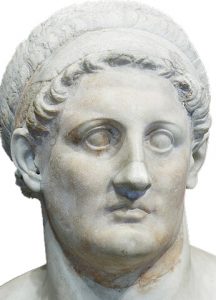 Ptolemy I, called Soter, son of Lagos and Arsinoe, was born in 367/366 or 364 BC and died in 283. Founder of the Ptolemaic dynasty, personal friend and 0-48general of Alexander the Great, he was the first Greek king of Egypt, who arranged for the body of the Macedonian general to be transferred to Alexandria and a mausoleum to be erected. In the last years of his reign, Ptolemy I turned to history and gave the most reliable and detailed account of Alexander’s actions. Unfortunately, only fragments of his work have survived, and these are through Arrian, from which no conclusion can be drawn about the cultural visions of the Macedonian general.
After the death of Alexander the Great in 323 BC and the division of his empire by the Treaty of Babylon, he assumed the satrapy of Egypt to which he also annexed Cyrenaica. He also acquired Alexander’s body in 321 BC during its transfer to Macedonia, and kept it in Egypt, where this is the last known location of Alexander the Great’s tomb. Ptolemy is said to have instigated the relocation of the capital of Alexander the Great’s Empire to Babylon. He tried and succeeded in keeping Egypt under his rule against the attacks of the other successors to the throne. He gained great prestige, mainly due to his prudent administration but also to his respect for the religion and customs of the Egyptians.
His separatist tendencies, in order to separate Egypt from the other provinces, were manifested after the immediate extermination of Cleomenes, who managed the finances of Egypt. His act provoked the reaction of Perdiccas, who wanted to maintain the unity of the empire and to emerge as the successor of the empire. In 321 BC, however, he was killed trying to invade Egypt. Then Ptolemy I fought with Antigonus in 315 BC and 312 BC. and after his defeat at Salamis in Cyprus in 306 BC by Demetrius the Sieger, he was forced to abandon the island.
In 306 BC he was named king, he designated Alexandria as his seat, which in his time was adorned with splendid palaces and public buildings, culminating in the Lighthouse of Alexandria, one of the Seven Wonders of the Ancient World. During the siege of Rhodes in 306 BC by Demetrius the Sieger, Ptolemy effectively helped the besieged by sending supplies and reinforcements, which led to the salvation of the city, and thus he acquired the name Ptolemy the Savior from the Rhodians. In 285 BC abdicated in favor of his second-born son, Ptolemy II Philadelphus. The last heir to the Ptolemaic Dynasty was Queen Cleopatra, who opposed Egypt’s annexation to the Roman Empire.
His personality acquired world-historical significance, as he is the founder of the eponymous Lagid-Ptolemaic Dynasty in Egypt, which ruled the country for about 300 years.
He moved the capital of the state from Memphis to Alexandria, mainly for economic reasons, and founded the Greek city of Ptolemais in Upper Egypt as a counterweight to the Egyptian city of Thebes.
He was a patron of letters, and at the instigation of Demetrius of Phalerum, he founded the city’s Museum, which housed the great Library of Alexandria, which contained 200,000 volumes at the time of his death with all the sciences of the time, and which was initially set on fire in 48 BC by the Roman fleet of Julius Caesar, which resulted in the fire spreading to the Library of the Museum and was completely destroyed. It was later rebuilt, but in 391 AD it was set on fire again under Theodosius I.
Finally, Ptolemy returned to the Egyptian priests statues of gods, furniture and books that had been stolen from the sanctuaries by Xerxes I.
He himself wrote the book On the Acts of Alexander, which has not survived but is mentioned in a work by Arrian, the well-known biography of the general Alexander the Great, the Anabasis.
As early as 290 BC, he appointed his son by his third wife Berenice, Ptolemy II, as his successor, preferring him to the son he had had by his second wife Eurydice, daughter of Antipater, the well-known angry and violent Ptolemy Keraunos.