
Alexander IV, the son of Alexander the Great
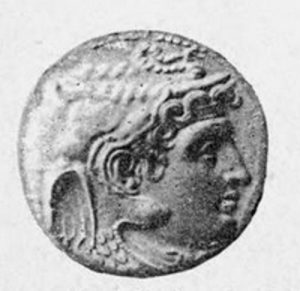 The legitimate heir to the throne – the son of Alexander and his wife, Roxane, Alexander IV – would not be among those who would be called by history “Successors of Alexander”, as he was murdered along with his mother on the orders of Cassander.
However, in addition to Alexander IV, who was murdered at a young age, before reaching adulthood, the Macedonian general is said to have had a second son – although, based on historical sources, this is not confirmed with absolute certainty, as Heracles of Macedon, although (supposedly) the firstborn, was not a legitimate son, but an illegitimate one, by Alexander’s mistress, Barsine. Barsine is described as a Persian noblewoman, and Heracles (who bore the name of the mythical hero who was supposed to be the ancestor of the Argeads of the Macedonian royal family) is thought to have been born in 327 BC, four years before Alexander IV.
Barsine is said to have been the daughter of the satrap Artabazus of Phrygia. As for the ancient sources, Plutarch and Justin mention Barsine and Heracles, but Arrian does not. Plutarch says that Alexander took her as his mistress, but at the suggestion of Parmenion – and it is known that Alexander and Parmenion, especially from a certain point on, had many differences, culminating in the execution of the experienced general and his son, Philotas, under strange circumstances.
Also, the author Mary Reno, who had written a series of books (both historical novels and non-fiction works) about Alexander, notes that there is no record of such a woman accompanying the ecstasy, nor any claims from her or her family about a child – however, 12 years after (Alexander’s) death, a 17-year-old boy appeared who was supposedly raised in Pergamum. It is noted that Alexander had also married another Barsine.
This is the daughter of Darius, Stateira, who is also referred to in Greek sources as Barsine. According to Reno, this must have helped to “support” the whole story, but she emphasizes that there is no source that states that Alexander was involved or paid any attention to the child – and, since his son with Roxane was born after his death, Heracles would have been, while he was alive, his only son: “For a man who named cities after his horse and his dog, it is difficult to believe this.” The question also arises, if he was indeed his son, how he was not drawn into the succession struggle earlier, and why he was “passed over” in favor of Philip of Arrhidaeus, Alexander’s mentally retarded/disabled half-brother.
Heracles lived in obscurity until the assassination of Alexander in 4 BC, when Polyperchon, Alexander’s general, began to promote him as the true heir to the throne – until he came into conflict with Cassander, who eventually reached an agreement with him, in the context of which Polyperchon killed Heracles.
As can be easily understood, it cannot be said with certainty whether Heracles was indeed Alexander’s son – even if illegitimate.
In any case, the fate of Alexander’s potential blood heirs is known: They all became pawns of more powerful “players” and met their death at their hands. Philip Arrhidaeus became a puppet in the hands of Perdiccas and was assassinated on the orders of Olympias, Alexander’s mother (who had allied herself with Polyperchon and was a powerful factor in the succession conflict, until she was stoned to death after her defeat, by order of Cassander, who had become king of Macedonia).
Also, as mentioned above, Alexander IV was poisoned along with his mother, also by order of Cassander, after his victory over Olympias’ forces: The son of Antipater (who never had good relations with Alexander himself) wanted to avoid in this way the emergence of a strong competitor for the throne when Alexander IV, the legitimate successor of the Macedonian general, came of age.