
Who were Alexander’s successors?
The sudden death of Alexander the Great in the summer of 323 BC redefined the socio-political and economic vortex that had been set in motion by the previous conquest of Asia and the collapse of the Achaemenid state.
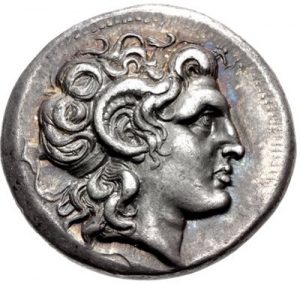 As Alexander’s immediate successors were weak, the vast expanse that had just been conquered was at the disposal of dynamic and ambitious Macedonian officials, who engaged in a furious struggle to consolidate new, as extensive and powerful as possible, states.
The Successors, beyond their boundless ambition and philarchy, shared, in addition to one, another fate, characteristic of the era and the new morals of the Hellenistic era that had just dawned. That of violent and often unexpected death.
We will limit ourselves only to those who were surrounded by the royal office, excluding those who exercised high power through the administration of the territory, the regency of the time.
Philip Arrhidaeus
Alexander was succeeded by his half-brother Philip Arrhidaeus (c. 359-317 BC), a man mentally unstable and unfit for the kingdom. He was an instrument of the powerful of the time and only his wife Eurydice took care of his rights. In the battle for the crown of the ancestral land, they were defeated by Olympias who promoted her grandson Alexander IV and were imprisoned. Philip was speared in their cell by Thracian mercenaries and his wife was forced to commit suicide.
Alexander IV
With the death of Arrhidaeus, Alexander the Great’s son, Alexander IV (323-309 BC), took power, formally king from birth. After the death of his grandmother Olympias, who was stoned to death by Macedonian nobles in 316 BC, he lost his only support. He spent the rest of his life as a prisoner of Cassander, who saw him as an obstacle to his plans and eventually ordered the poisoning of himself and his mother Roxane. Thus the line of Alexander the Great died out.
The death of Alexander IV marked the end of any thought of the unity of Alexander the Great’s territory and gave rise to the open manifestation of the ambitions of the various local rulers, which led to successive wars. In order to legitimize their power, especially in the eyes of the rest of the Greeks, these new rulers promoted the right of the conqueror, the dorictiton, over the hereditary right of the traditional monarchies, whether they had overthrown them or were fighting them.
Antigonus Monophthalmus (382-301 BC)
Antigonus was of noble birth and served as a general first under Philip and then under Alexander. He did not follow the army to India as he was appointed satrap of Phrygia. An excellent general and intelligent politician, he was the strongest of the Diadochi and the only one who sought the unity of the territory but under his authority. He was the first to proclaim himself king in 306 BC. He fought for his cause until the end, having his beloved son Demetrius at his side. He was killed fighting, despite his age, at the Battle of Ipsus in 301 BC.
Lysimachus
Lysimachus (c. 360-281 BC), although his father was originally from Thessaly, grew up in the environment of the Macedonian royal court. He served as one of the seven royal bodyguards and fought throughout the Eastern campaign. After the death of Alexander he was appointed general of Thrace. He expanded his power through fierce struggles and, as king from 306 BC, reigned briefly in Macedonia as well. His turbulent family life had an impact on the cohesion of his territory, culminating in the unjust execution of his firstborn son Archelaus, who was very popular with his subjects. He was killed during the battle of Kouroupedium in 281 BC and remained unburied for several days. His body was identified by his purple sandals and by his dog that stayed close by, protecting his master from the vultures.
Seleucus I Nicator
Seleucus (c. 358-281 BC) was the son of Macedonian nobles and thus from a young age joined the royal cadets. He fought throughout the Eastern campaign and came to command the elite body of royal guards. He was named satrap of Babylon by the Treaty of Triparadisus in 321 BC and went through many adventures until he consolidated his power. In this effort, he repeated Alexander’s campaign, reaching, again, the Indus River.
He founded dozens of cities in order to organize and control his vast territory. At the peak of his life, he defeated Lysimachus at the Kouroupedion and now possessed all of Alexander the Great’s territory, except for Egypt. Since Ptolemy had died earlier, Seleucus was the last surviving companion of the great king. In his advanced age, he decided to return to his ancestral land and be crowned king of Macedonia, leaving Asia to his son Antiochus. However, as soon as he crossed the Hellespont, he was assassinated, in front of his entourage, by one of his proteges, Ptolemy Keraunos.
Ptolemy
Ptolemy (c. 367–282 BC) was a Macedonian noble and perhaps illegitimate son of Philip II. Throughout the Eastern campaign he was one of Alexander the Great’s closest and most trusted companions, one of his seven bodyguards. By the Treaty of Babylon in 323 BC he was named satrap of Egypt and later managed to intercept Alexander’s body which had been sent to be buried in Macedonia.
He was the most far-sighted of the Diadochi, and his involvement in the wars that followed never exposed the core of his territory to immediate danger. He also adopted the royal title in 306 BC. and wisely governed his rich and isolated country, adopting the title of pharaoh. He wrote a great historical work about Alexander that did not survive. He chose as his successor his son by his second wife Berenice, pushing aside, probably because of his violent character, the firstborn Ptolemy Keraunos who left Egypt. He died at a full age, leaving power to Ptolemy II.
Epilogue
These young monarchs who had been pitting each other against each other for years without mercy had been comrades and fellow warriors, perhaps even friends. However, by the end of Alexander the Great’s campaign, they were no longer the same. They had taken part in unprecedented feats, the equivalents of which had until then only existed in myths, they had felt the world widening at their every step and had understood that their audacity and valor could secure them fame, wealth and power.
Power, even kingship, was no longer a matter of origin or destiny. It had become a trophy at the disposal of every adventurer, who could, thanks to ambition, personal abilities and the vicissitudes of fortune, enjoy the highest greatness. Even if it meant paying for it with an untimely or violent death.