Seleucus I Nicator and the Rise of the Seleucid Kingdom
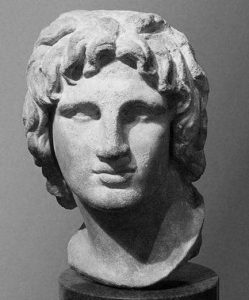 Seleucus I, Nicator, was born in the ancient city of Evropos in Macedonia, in present-day N. Kilkis, from a noble family. Note that in Macedonia there was another city with the same name, Evropos, in the present-day province of Almopia. Seleucus’ father was called Antiochus, he was a general of Philip, and his mother was called Laodice. He was about the same age as Alexander the Great and followed him in the campaign against Asia. He was born between the years 354 and 358 BC. He belonged to the class of “partners” “whose presence in Europe is confirmed by the imposing presence of a plundered and destroyed Macedonian tomb today.
Seleucus I distinguished himself as the leader of the auxiliaries, that is, the infantry of the royal guard of Alexander the Great, at the crossing of the Hydaspes River (326 BC). Shortly afterwards he was placed at the head of a phalanx and in the multiple marriages that Alexander organized, wanting to initiate his companions into eastern customs by marrying them to Persians, Seleucus married Apama in 324 BC, daughter of the Bactrian Spitamene. His wife’s name was probably Hellenized into Antiochis. At an advanced age, in 299 BC, he married in Pieria the young Stratonice who was known in history as Stratonice of Syria.
The name of Seleucus is mentioned in the list of friends of Alexander the Great, who consulted Bel Serapis, when the great king fell ill. At that time he held the position of leader of the young men of the royal guard and from his position he protected the general Perdiccas from the rebels who pursued him to the entrance of the chamber, where Alexander lay dead (323 BC).
Perdiccas rewarded him and promoted him to the rank of commander of the cavalry of the allies, a great position, which Hephaestion and Perdiccas himself had held before him. At that time Seleucus was thirty (30) years old. Handsome, imposing, taciturn, calm and vigorous. It is reported that he managed to capture a raging bull unarmed! He maintained the aforementioned position for three years and followed Perdiccas to Cappadocia, Pisidia and Egypt, where he finally sided with the rebels who moved against Perdiccas. He occupied one of the first positions in the succession of Alexander the Great.
In the conflicts between the successors, a long-term struggle for which there are many references and detailed records in a rich bibliography, he emerged as king of Syria (305-271 BC), leader of a dynasty and founder of the Seleucid state. After many struggles, he consolidated his rule in Asia Minor, invaded Thrace in 281 BC, heading towards Macedonia, where he wished to spend the rest of his life. In the city of Lysimachia, he was murdered by Ptolemy Keraunos, because he did not help him, as he had promised, to seize the throne of Egypt. The body of Seleucus, who was then 75 years old, was purchased by Philetaerus of Pergamum. He transported it to Seleucia, which was located on the Orontes River, buried it and erected an epitaph temple that became known as the Nikatorion.
Seleucus I was succeeded on the throne of Syria by his son and successor Antiochus I, who was called the Savior. In the entire Seleucid dynasty, six kings with the name Seleucus reigned, the last being Seleucus VI the Magnificent, and thirteen with the name Antiochus, the last being Antiochus XIII the Asian, in whose days the famous kingdom was destroyed by the Romans.
Seleucus Nicator was an important leading figure. All ancient writers praise his bravery, courage, philanthropy, generosity and kind behavior. Many cities expressed their gratitude to him with their resolutions and in others, such as in Ilion (Troy) and Miletus, divine honors were attributed to him.
He had given orders for the exploration of the Caspian Sea and India, he founded more than thirty cities in Asia, to which he gave names of his father Antiochus (Antioch), his mother Laodice (Laodikeia), his wife Apama (Apameia), the special homeland of Europos (Europos (Dura) in Upper Syria, Europos of Mesopotamia and Europos of Media), cities with names of cities of Macedonia, (Pella, Cyrus, Edessa, Apollonia, Veria), and other cities of Greece (Larissa). He named the Orontes River Axios and gave the name Pieria to a large area of his territory.
He kept his wife Apama, a Bactrian princess, close to him, unlike the other successors of Alexander, who after the death of the great king divorced their Persian wives. Coins with symbols of his military and political activities, as well as statu