
Who was Aesop
Aesop was the great Greek mythographer of the 6th century BC. he was an enigmatic figure even in his own time, let alone that later myth was employed to fill the gaps in his biography. Or his very existence. Herodotus called him a “reasoner” and Plutarch described him as a proverbially ugly and straggling slave who stammered.
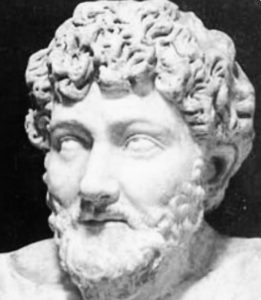 Everyone admitted, however, that he was a particularly perceptive man with a keen social eye, which is why his myths were nothing more than didactic allegories about life itself and the human factor. Like the epic poet Homer, there are many cities and countries that still fight to claim him as their own. His origins, like his biography, are lost in the depths of time and only guesses can be made as to the hows and whys of his existence, as the Aesop phenomenon will progressively take shape over the centuries.
Notorious for his ugliness, Aesop, as legend and Plutarch tell us, was misshapen: he had a disproportionately large head in relation to the rest of his body, a snub nose, puffy lips, a hunchbacked body and a large protruding belly, characteristics that gave him the name Aesop, that is, Ethiopian.
He probably limped and even stuttered! The rhetorician Imerius even confesses that it was not only his fables that caused laughter, but also Aesop’s very figure, his voice and his way of speaking. Aesop was undoubtedly a slave, but there is no historical consensus whether he was a slave from birth or was enslaved due to captivity or debts.
His master is given by the “Bios” and most sources as the philosopher Xanthos of Samia, although Herodotus, our oldest source, refers to Iadmon of Samia, a version that Aristotle also accepted in his now lost “Samian Republic”. Later texts also speak of Timarchus of Athens. Whatever the case, Aesop spent a good part of his slavery in Samos, where he would eventually grant him his freedom after the slave’s wise advice on how the Samians could escape the all-powerful king of Lydia, Croesus. Free and known from his oral tales as a wise storyteller, he later served as Croesus’ royal advisor.
In the late 4th century BC, the itinerant philosopher and statesman Demetrius Falireus publishes the first known edition of Aesop’s fables, more or less sealing the face of the ancient storyteller. But what is truth and what lies? In fact, he wrote his first biography in the 14th century AD. the Byzantine monk and scholar Maximos Planoudis, grafting myths and folk tales of his own time with the minimal biographical information handed down to us by the ancient authors. And so the greatest storyteller of antiquity remains largely one of the great unknowns of the spirit, as today many scholars of Aesop question the very fact that he was a man!
The “father” of the ancient myth, this visionary of the so-called “didactic mythology”, nevertheless survived despite his incomplete biography because his work was one of those that come to stay. When Aesop formulated his symbolic fables in his satirical style, the world had already found its greatest storyteller. His anthropomorphic animals in personality traits would raise generations and generations of children the length and breadth of the world, his short stories, couched in austere brevity, noted for their moralizing role.
Of course, he himself did not write a single word, preferring to tell his stories orally. And probably, judging by its rumored ending, he was right not to capture the uncomfortable truths of his myths in writing. Aesop’s fable is a short narrative of a paradigmatic nature that draws elements from folk wisdom as well as philosophical criticism. That is, a short incident with protagonists animals usually – but also people or gods sometimes -, which serves to highlight or embellish characters and attitudes.
It is said that the former slave was sent to the Oracle of Delphi by King Croesus to get an oracle, but he chanted it to the priests accusing them of deceiving the world! And so he was quickly condemned to death and thrown from the top of Parnassus, as his words disturbed many. Despite the fact that he was of humble origin and once a slave, the Athenians later erected a statue of him to show that every man of worth should be honored no matter how he came into the world.
What an ideal conclusion to the life of a man who seemed to have stepped out of some myth! The Greeks saved his myths by word of mouth, until they were finally recorded in the Greek period and survived through the centuries as excellent examples of allegorical speech with enormous learning value for young and old children.
What did Aesop teach the world? That gratitude is a characteristic of noble souls, that lack of trust is a harbinger of misery, that want knows no laws, that misfortune tests the sincerity of friends, and revenge will ultimately injure the avenger. “Clothes may cover a fool, but his words will reveal him”, the great storyteller tells us, warning us: “Be careful not to miss the point trying to catch the shadow”.
Very little is known about where and when Aesop was born. The most common version is 625 BC, and his specific homelands have been suggested from Phrygia – in modern-day Turkey -, Samos and Athens, to Sardis (capital of Lydia), Mesimbria (a Greek colony in Thrace), Egypt, Ethiopia and other African corners. Aesop was also dark-skinned and his fables feature animals unknown to Ancient Greece.
Was he from his particular place of origin or was it the result of his many years of travels to unknown and exotic places? We will probably never know. There is now a section of historians who question his existence or the fact that he was a human being, a line of thought that seems to have existed since the classical period. There are writers who believe that Aesop, just like Homer and Hesiod, is more the construction of an emblematic figure representing an archaic literary genre (the myth here), than an actual author.
The grammarian Theon, referring to the Aesop fables, emphasizes that they take their name not from their creator, but because he used them most frequently and with the greatest art. Various fables that are also attributed to Aesop are in fact already found in the work of poets such as Hesiod, Archilochus and Simonides, at the same time that some of the anecdotal narratives that demonstrate his wisdom have other wise men of the ancient world as protagonists in other situations, such as Bias of Priene, Thales, Pittacus and Solon.
Aesop is mentioned by both Herodotus and Aristophanes, as well as Plutarch, who in the “Symposium of the Seven Wise Men” has him test the sayings of the seven sages of antiquity with his wit and wisdom. The most important biographical source is “The Life of Aesop”, a work that dates back to the late 1st century BC or the early 1st century AD and was probably written in Alexandria. This is another biography that is full of fictional elements and fictional stories, even incorporating many incidents from Aesop’s fables into the biography!
Aristotle and his students, however, were particularly interested in Aesop, concluding in their own version that he was a Thracian and not a Phrygian. The most prevalent version, however, tells us that Aesop was born in 625 BC in Amorium (or Cottiaeum) in Phrygia (most sources mention him as Phryga or Lydo) into a family of slaves owned by the philosopher Iadmon. As a slave on the estates or a shepherd in his master’s flocks, he lived a difficult childhood, although he did not stop fighting for justice. We are told of an incident that led to his sale: one day he saw a foreman unjustly beating another slave and immediately rushed to ask him why.
The matter reached the owner, who took him to the slave market of Ephesus to get rid of him. Fortunately for him, he was bought by Xanthos from Samos, an enlightened man who appreciated his slave’s gifts and took him with him on his travels to see the world. According to other sources, he was sold to Iadmon the Samian, who here is his second master and the one who traveled him to the four corners of the known world. In any case, the new owner appreciated the great spirit of his slave and freed him at some point.
[ez-toc]
The fables of Aesop
 Aesop’s Fables are a collection of ancient moral tales credited to Aesop, a storyteller believed to have lived in ancient Greece between the 6th and 5th centuries BCE. Although the exact origins and authorship of the fables are uncertain, they have been passed down through generations and remain popular throughout the world.
These fables often feature anthropomorphic animals or inanimate objects that act and speak like humans, presenting moral lessons or conveying simple truths about human nature and behavior.
These are small domestic narratives, formulated with great brevity. Their character is didactic, symbolic and allegorical. These Myths have a special grace, wonderful simplicity and unfathomable teaching.
They are taken from everyday life and nature. He had the unique ability to give animals human qualities, soul and speech, to such an extent that you believe that his fables were once reality and all that he narrates has happened. A key feature of his stories was the epimythium which was understandable for children and the people.
Aesop’s Fables (Aesopou’s Fables) were written in prose. As is well known, until then, only metered speech, poetry, was considered the only expressive genre for writers. Therefore, it can also be considered as a pioneer in its kind. Their ideology is the rejection of evil in its most representative forms: violence, fraud, arbitrariness, betrayal, vanity, arrogance, falsehood, greed, cunning.
The disapproval is attempted sometimes by reference to the Divine judgment, sometimes by persuasive suggestions, but more often by establishing the absurdity of evil, by ridiculing it as well as by the philosophical contemplation of life.
According to Herodotus, Aesop was a well-known “rhetoricist”[8]. Besides fables, he knew and told many jokes and anecdotes. Others argue that he did not create myths but collected them, completed them and perfected them.
They came either from the most ancient Greeks or from other peoples, such as the Phrygians. Of course, it is possible that he invented some of them himself. However, he used them a lot in his life, with such skill and success that his name was eventually associated with them.
It is said that he told these myths not only during his lifetime but also in order to support his innocence in court. In them, his broad, observant spirit and his ability to teach with small, simple stories, which always have a moral lesson at the end, can be distinguished.
Aesop used with his observation and deep wisdom to fashion such stories and tell them around him. In time he gained a great reputation and everyone ran to him to hear some of his fables about some of their problems. Little by little his myths began to be transmitted by word of mouth among the people, until the Hellenistic era when they were collected for the first time.
The Fox and the Grapes fable
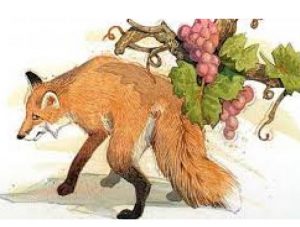 Once upon a time, there was a clever and hungry fox who roamed the countryside in search of food. One hot summer’s day, as the fox was walking through a vineyard, he noticed a luscious bunch of grapes hanging from a high vine. The grapes were ripe and juicy, their purple color tempting the fox with their sweetness.
Excited by the sight of the grapes, the fox’s mouth began to water, and he immediately desired to taste them. He leaped up, trying to reach the grapes, but they were hanging just out of his reach. Undeterred, the fox backed up, took a running start, and made another leap, but the grapes remained elusive.
The fox tried several more times, jumping with all his might, but each time he fell short. Exhausted and frustrated, the fox finally gave up, sitting down at a distance, panting heavily. Disappointed, he muttered to himself, “Those grapes are probably sour anyway. I’m sure they’re not worth the effort.”
And with that, the fox turned his back on the grapes, pretending not to care anymore. He walked away, trying to convince himself that he didn’t want them after all.
The moral of the fable is that sometimes people tend to belittle or reject things they desire but cannot obtain. In this story, the fox, unable to reach the grapes, tries to console himself by claiming they are sour and not worth his effort. The fable highlights how individuals often rationalize their failures or disappointments by diminishing the value of what they desire but cannot attain.
The Boy Who Cried Wolf fable
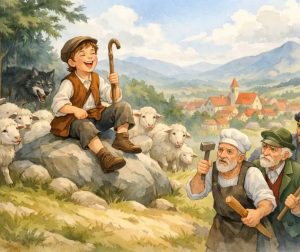 Once upon a time, in a small village nestled in the hills, there lived a young shepherd boy named the boy. the boy had a mischievous streak and loved to play pranks on the villagers and his fellow shepherds. One day, while tending to his flock of sheep, an idea popped into his head. He thought it would be amusing to create some excitement and see the villagers come running, even if there was no real danger.
So, the boy climbed up a small hill, where he could see the entire village, and shouted at the top of his lungs, “Wolf! Wolf! The wolf is attacking the sheep!” The villagers, alarmed by the cries, dropped whatever they were doing and rushed towards the hill, carrying sticks and pitchforks, ready to defend the sheep.
But when they reached the top of the hill, all they found was the boy, laughing mischievously. “Ha! There was no wolf,” he exclaimed, delighting in his prank. The villagers were annoyed but forgave him, warning him not to cry wolf when there was no danger.
Days passed, and the boy grew bored with his routine duties. Remembering the excitement his prank had caused, he decided to do it again. Climbing up the hill, he shouted, “Wolf! Wolf! Please help, the wolf is attacking the sheep!” Once more, the villagers, concerned for the safety of the flock, dropped everything and rushed up the hill. And once again, they found the boy grinning, reveling in the chaos he had created.
The villagers were furious this time. “You foolish boy! We won’t fall for your tricks again,” they scolded him, shaking their heads in disappointment. They left, muttering about how he needed to learn a lesson about honesty.
Weeks passed, and the boy’s pranks were forgotten. One sunny day, as the boy watched over the grazing sheep, a genuine sense of fear washed over him. He saw a large, menacing wolf approaching the flock. Terrified, he called out as loud as he could, “Wolf! Wolf! Help! The wolf is really attacking the sheep this time!”
But this time, the villagers ignored his cries. They had grown tired of his lies and believed he was playing another prank. They continued with their tasks, paying no heed to his desperate calls for help. The wolf lunged at the sheep, snatching one after another until the flock was decimated.
the boy realized his foolishness and the consequences of his actions. He had lied too many times, and now no one believed him, even when he spoke the truth. His heart sank as he witnessed the devastation caused by his earlier deceit.
From that day on, the boy learned the importance of honesty and the consequences of lying. The once playful boy became a responsible shepherd, always truthful and trustworthy. And as for the villagers, they learned a valuable lesson as well—to distinguish between genuine calls for help and deceitful cries, for sometimes, actions have consequences that cannot be undone
The Lion and the Mouse fable
 Once upon a time, in the heart of a dense forest, a mighty lion ruled over all the animals with power and fear. The lion was large and strong, and none of the creatures dared to challenge its authority. One day, while roaming through the forest, the lion was caught in a hunter’s net. Thrashing about in desperation, the lion’s mighty roars filled the air, but all in vain. It seemed that the king of the jungle was trapped and helpless.
Meanwhile, a small mouse happened to be passing by. Curiosity piqued, the mouse cautiously approached the source of the commotion. As it saw the trapped lion, the mouse’s heart filled with sympathy. Despite its size, the mouse resolved to help the mighty lion escape from the hunter’s net.
Approaching the lion, the mouse asked, “Do not fear, mighty lion. I shall gnaw through these ropes and set you free.”
The lion, struggling to free itself, couldn’t help but chuckle at the mouse’s proclamation. However, it didn’t dismiss the mouse’s offer, realizing that any help was better than none. With a nod, the lion agreed.
The small mouse scurried around the net, gnawing and biting at the ropes with all its might. Slowly but surely, the tiny creature managed to cut through the net, setting the lion free. The relieved lion stretched its powerful limbs, gratitude shining in its eyes.
“Thank you, little mouse,” the lion exclaimed. “You have saved my life, despite my initial doubts.”
The mouse humbly replied, “It was nothing, mighty lion. We should help each other, no matter our size or strength.”
The lion, now humbled by the mouse’s act of kindness, realized the truth in the small creature’s words. From that day forward, the lion vowed to show compassion and mercy to all the animals of the forest, regardless of their size or power.
Time went by, and word of the lion’s change of heart spread throughout the animal kingdom. The animals, no longer living in constant fear, approached the lion with their problems, seeking its wise counsel and protection. The lion became known as a fair and just ruler, earning the respect and loyalty of its subjects.
And as for the small mouse, it lived happily in the forest, knowing that even the mightiest of creatures could be grateful for the help of the smallest and humblest of beings. The fable of “The Lion and the Mouse” served as a timeless reminder that acts of kindness, no matter how small, can have a significant impact and create a bond of friendship between unlikely allies.
The ant and the grasshopper fable
 Once upon a time, in a sunny meadow, there lived an ant and a grasshopper. The ant was diligent, hardworking, and always preparing for the future. Meanwhile, the grasshopper was carefree, spending its days hopping around, chirping and enjoying the pleasures of the present.
As summer approached, the ant began to gather food and store it in its anthill. The grasshopper, on the other hand, continued to sing and dance, not paying any attention to the approaching change in seasons.
When winter arrived, the meadow was covered in a thick blanket of snow. The grasshopper, who hadn’t made any preparations, found itself hungry and shivering in the cold. It realized that it had been foolish not to think about the future and its needs.
Desperate and hungry, the grasshopper went to the ant’s anthill and humbly asked for some food. The ant, who had worked hard all summer, had plenty of food stored away. But it was not pleased with the grasshopper’s laziness and lack of foresight.
“Why should I give you food when you spent all summer singing and dancing instead of preparing?” the ant scolded.
The grasshopper, feeling regretful, pleaded for forgiveness and promised to change its ways. It admitted its mistake and asked for a chance to work and contribute.
The wise ant, considering the grasshopper’s sincerity, decided to give it a lesson. It offered the grasshopper some food but told it to work alongside the ants in the spring and summer, gathering food for the next winter.
From that day on, the grasshopper realized the importance of hard work and planning for the future. It diligently worked side by side with the ants, learning the value of preparedness and responsibility.
The moral of this fable is that it is wise to plan for the future and work hard in the present. Neglecting responsibilities and indulging in laziness can lead to difficulties and regret later on.
The Tortoise and the Hare fable
Once upon a time, in a peaceful meadow, there lived a Tortoise and a Hare. The Hare was known for his incredible speed, boasting about his swiftness to anyone who would listen. The Tortoise, on the other hand, was slow and steady, always taking his time to complete tasks.
One sunny day, the Hare spotted the Tortoise slowly making his way through the meadow. With a mischievous gleam in his eye, the Hare decided to mock the Tortoise. “Why are you so slow?” the Hare asked, chuckling. “You’ll never get anywhere at this pace!”
The Tortoise, unaffected by the Hare’s taunting, replied calmly, “Slow and steady wins the race, my friend. We’ll see who reaches the finish line first.”
Amused by the Tortoise’s confidence, the Hare proposed a race. He was certain he would win, so he agreed to the challenge without hesitation. The other animals in the meadow gathered around, eager to witness the spectacle.
On the day of the race, the Tortoise and the Hare stood side by side at the starting line. The Hare’s supporters cheered him on, confident of his victory, while the Tortoise’s friends encouraged him to do his best.
With a signal from the crow acting as the race official, the race began. The Hare sprinted off like lightning, leaving the Tortoise far behind. The crowd gasped in awe at the Hare’s speed, convinced that the race was already over.
Meanwhile, the Tortoise maintained his slow and steady pace, undeterred by the Hare’s impressive lead. He focused on putting one foot in front of the other, determined to stay true to his nature.
As the Hare ran ahead, he grew overconfident. He thought he had so much time to spare that he could afford to take a nap before reaching the finish line. So, he found a comfortable spot under a shady tree and dozed off, confident of his victory.
While the Hare slept, the Tortoise continued to plod along. He passed by the slumbering Hare, his progress unnoticed by the dozing speedster. The Tortoise’s slow and steady pace allowed him to make steady progress, step by step, while the Hare snoozed away.
Finally, the Tortoise approached the finish line. The crowd erupted in cheers and applause, astonished by the Tortoise’s unexpected progress. Just as he crossed the finish line, the Hare woke up, realizing with a start that he had fallen asleep.
Rushing to the finish line, the Hare was shocked to see the Tortoise already there, basking in the glory of his victory. The Hare felt a deep sense of regret and embarrassment, realizing that he had underestimated his opponent.
The moral of the fable of “The Tortoise and the Hare” is that slow and steady progress, combined with determination and perseverance, can often overcome swift but careless speed. It teaches us to avoid overconfidence and to appreciate the value of consistency and focus in achieving our goals.
Edition of Aeop’s fables
A selection of Aesop’s fables in prose was published by Dimitrios Falireus at the end of the 4th century BC. This collection is not preserved and only poetic elaborations by Bavrius in Greek, Phaedrus in Latin and others, saved the material of that epitome. All extant collections are much later and date from the 1st or 2nd century onwards. His fables have been collected in “Collection of Aesopian Fables”.
They were first printed in Milan in 1479 AD, in Venice in 1525 and 1543 by the family of printers Damiano di Santa Maria followed by an edition in Paris in 1547.
Adamantios Korais printed them in 1810 in Paris followed by a critical edition in 1852 in Leipzig from Halm. Since then many editions have appeared and the Myths are believed to have been read worldwide almost as much as the Bible.
Their most recent edition was by the British publishing house Penguin (1997) in 50,000 copies. Their translation into the modern Greek language was made by Andronikos Noukios and Georgios Aitolos, who lived in the 16th century.