What are the most important sights of Kos
Asklepieion
In ancient times it was a place of worship of the god Asklepios and a place of healing and teaching of Medicine. Hippocrates, one of the most important representatives of medicine in antiquity, taught there in the school he had founded on the site of the Asklepieion. In contrast to the sanctuary of Asclepius in Epidaurus, scientific medicine was especially developed in Kos.
The Asklepieion of Kos, whose surviving ruins date back to the 4th century BC, is located southwest of today’s Kos town at a distance of about 3.4 kilometers. It dates back to the Hellenistic era, a point of view that is strengthened by the exploitation of the space presented by the three consecutive levels – an element of oriental architecture that entered Greek architecture with the conquests of Alexander the Great.
A decisive event that happened in Kos during the reign of the Ptolemies, in 260 BC, was the pan-Hellenic recognition of the right of immunity of the sacred area of Asklepios for the establishment of the solemn celebration of the Great Asklepion.
The pursuit by the Koos of granting asylum to any persecuted person who sought protection in the Asklepieion shows how proud the Koos were of its existence, at the same time considering the temple as the center of their city.
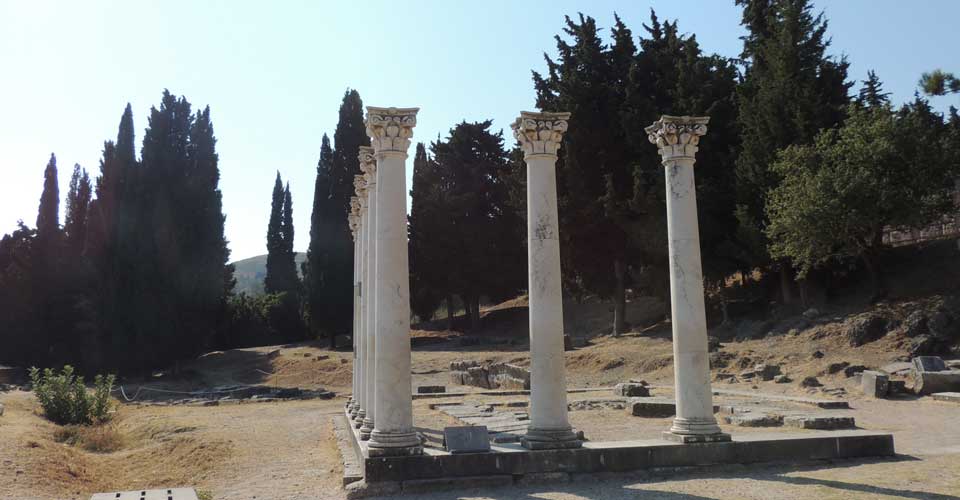
The discovery of the Asklepieion was made in 1902 by the German archaeologist Rudolf Herzog and the Kos historian Iakovos Zaraftis, who even calculated and indicated the correct position of the sanctuary.
The reason for intensifying the search for its discovery was the fourth mime of Herodas “Women with feasts and sacrifices in the Asklepieion”, in which the author shows his admiration and adoration for Kos, but also describes the images and statues from the Asklepieion.
Excavations were continued by Laurenzi (1930) and Morricone (1937-38), along with restoration and restoration work. It is worth mentioning that many objects from the excavations fled to Rome and Constantinople.
Ancient Agora of Kos
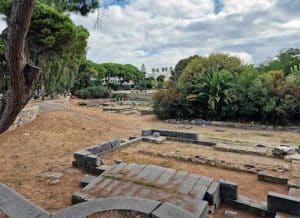
The market was the “heart” of the economic center of the island with streets, workshops, shops and altars that make up the “traditional” image of an ancient market.
The archaeological site was excavated by the Italian School of Archeology during the period of reconstruction of the city, after the devastating earthquake of 1933. The ancient market consisted of three main arcades, East, West and North, which in their center met in a large inner courtyard.
The North portico connected the market with the city walls, while the other two had various shops that served the daily needs of the citizens.
The frequent earthquakes that hit the island gave rise to continuous reconstructions of the city. The different materials used help distinguish the building phases. The earthquake of the 6th or 5th c. p.X. it left no traces in the building history of the city. In 366 BC and throughout the 3rd century, the buildings are constructed with amygdalopetra (a type of limestone) and greenish pumice stone for the foundation. Marble is rarer. In the following period, marble is widely used.
At this time (2nd century BC) the monumental building complexes that gave the city a majestic appearance were built. The reconstruction that followed the earthquake of 142 AD. (under Emperor Antoninus of Eusebius) changed the face of the city.
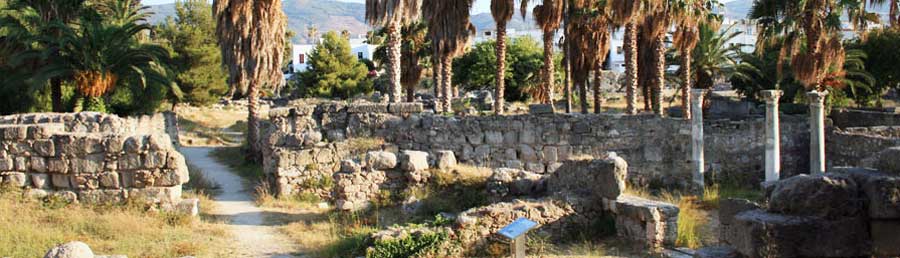
Cast masonry was used in the buildings, while in this period the thermal baths, the theater, the stadium were built and the market and the building blocks were reconstructed. The earthquake of 469 AD was decisive. (under Emperor Leo I) which means the end of the ancient city and the beginning of the early Christian period.
The excavation of the Greek archaeological service on the south side determined the length of the building to be approximately 300 meters. Further east from the ancient market, the excavations discovered part of the city’s urban plan (hippodameium) with wide streets (4 to 6 meters) and 4 building islands with houses and shops.
As an archaeological site, the market is part of the wider archaeological zone of the port, the part of which visible today covers an area of 152m in length and 82m in width. latitudinal.
In this zone, apart from the visible part of the market, the visitor can see part of the city’s fortifications, the sanctuaries of Aphrodite and Hercules, building islands with the remains of private houses, but also part of the city’s ancient port.
Finally, it is worth noting that the largest part of the ancient market is buried under the modern city. In fact, its southern part came to light with recent excavations opposite the altar of Dionysus, which led to the restoration of two columns that belong to the ancient market.
The Roman House ( Casa Romana )
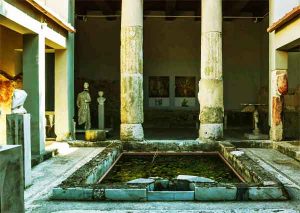
The Italian archaeologist Laurenzi undertook the excavation and then the Italian Administration proceeded with the complete restoration of the house, which was completed by 1940. It is a Roman villa of the Pompeian type of the end of the 2nd century and the beginning of the 3rd century AD, built on the ruins of a Hellenistic house with a wonderful drainage system.
It consists of 36 rooms and 3 outdoor areas, the atria or atria (from the Latin atrium). The external image of the building does not predispose the visitor to the extraordinary sight he will encounter. From the central entrance of the building, located on the eastern side, one begins to perceive the richness of the finds.
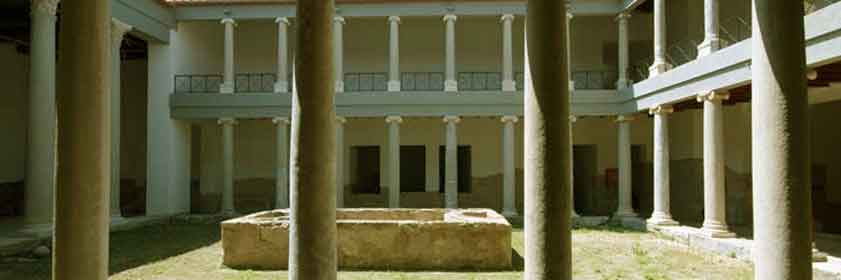
In the first atrium we find a small tank and on the floor an impressive and well-preserved mosaic depicting a panther devouring a deer. In almost all the rooms of the house one can find beautiful mosaics as well as rich decorations. In the main room of the house (androna) and in others there are traces of orthomarbling and mosaic floors with geometric ornaments, representations of tigers, panthers, etc.
The utility rooms are located on the north-west side, near the staircase leading to the upper floor. In each atrium we find small or large tanks and mosaics of various types with rich themes from Niriides to dolphins. In the building were also found statues of Nymphs, of Athena, as well as a mosaic with a representation of the seabed, which prove that the life of the house began at the end of the Hellenistic era. The visit to the Roman house takes the visitor to a fascinating era of the past.
Altar of Dionysus
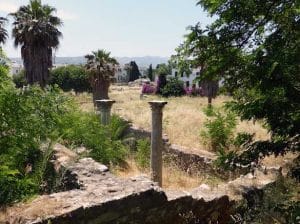
The surviving part of the structure dates back to the 2nd century BC, a period of prosperity for the city of Kos. It is assumed that the altar was built with the “sponsorship” of the king of Pergamum.
Later, during the Byzantine times, the temple was abandoned and when the John knights occupied the island, they used architectural members of the altar in the construction of the castle.
Several reliefs and amphiglyphic corner stones were found embedded there, which were removed in 1958.
The frieze of the Altar, which depicts scenes from the Amazon Battle and a Dionysian troupe with maenads, satyrs and Selenes, is kept in a special area in the city’s Castle.
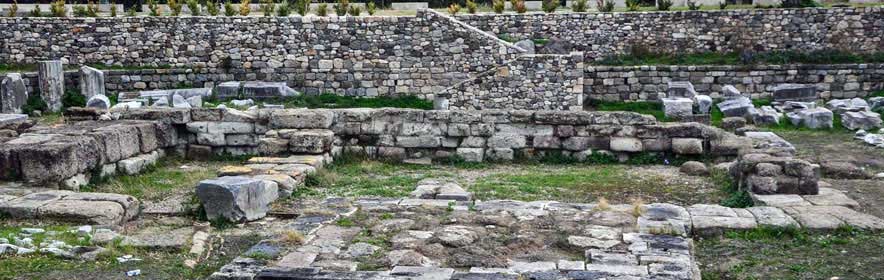
The archaeological site of the altar of Dionysus also includes a Doric temple on display, probably dedicated to Dionysus, and two rectangular structures interpreted either as statue pedestals or one as a statue pedestal and the other as an earlier altar.
Today, only a rectangular platform, i.e. the upper part of the foundations, the uphill entrance and a stone wall perpendicular to its interior, are preserved in good condition.
Temple of Heracles
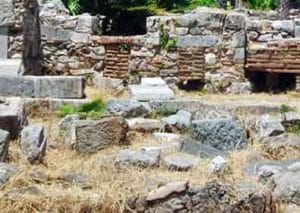
It has been designated as the Temple of Hercules thanks to an inscription found at the site, as well as other findings related to the myth of Hercules.
According to historical sources, after the leveling of the surrounding area in the 2nd and 3rd centuries AD. a peristyle with mosaics was created, one of which depicts the “Symposium of Hercules”. In the same area are buildings from later periods, such as a small thermal building and a baptistery.
Castle of Antimachia
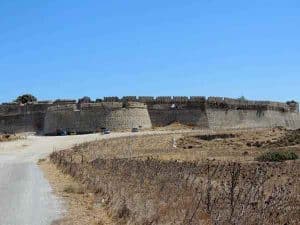
The castle has a triangular shape with the top towards the east. Each side of the castle is an independent fortification line, which follows the contours of the terrain. At the entrance is a massive crescent-shaped bastion with deep battlements.
The castle was renovated by the John knights in 1494 after a devastating earthquake. The existing walls were strengthened and restored and ramparts of various kinds were constructed along the outer wall. Inside the castle are preserved ruins of the old settlement of Antimachia, many cisterns as well as two old churches. The settlement was abandoned in 1840.
Castle of Neratzia
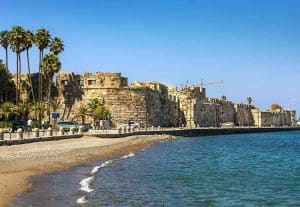
At the end of the 14th and beginning of the 15th century, Kos was densely planted with orange and lemon trees, which is why it was called Nerantzia and its castle the castle of Neratzia.
A wide moat separates the two precincts and only on the eastern side are they joined by an oblique downhill road.
The castle of Neratzia together with the castle of Agios Petros on the opposite coast of Ancient Halicarnassus controlled the sea passage to the Holy Land during the Crusades.
For the construction of the castle, many architectural elements from the ancient city of Kos and the Asklepiion have been used which can still be seen embedded in various parts of the castle.
In the 19th century, the Castle of Neratzia was used as a barracks for the Turkish garrison and the residence of the Turkish commander.
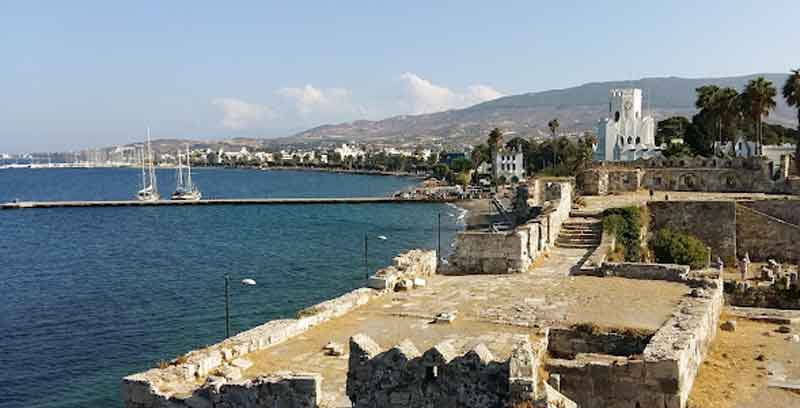
On March 17, 1816, a powder magazine accidentally exploded and destroyed a large part of the castle. Its current form is due to the Italian Archaeological Service which, during the Italian occupation, demolished the Turkish additions and proceeded with extensive works to restore the castle to its original form. During the German occupation, the garrison was garrisoned in the castle and the patriots were imprisoned
Castle of Pyli
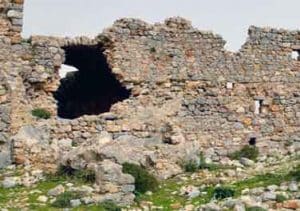
During the 15th century, when the John Knights occupied the island, they maintained and strengthened the castle in order to strengthen the defense of the area. From the castle, the view to the neighboring islands of Pserimos and Kalymnos and to the opposite coasts of Asia Minor is impressive.
In the settlement which has been characterized as “the Mystras of the Dodecanese”, many Byzantine churches have been preserved, among which stand out the church of Ypapanti from the 14th century with a wood-carved iconostasis and columns from a pre-existing ancient church as well as the church of the Taxiarchs.
It is worth noting that the founder of the Monastery of Patmos, Saint Christodoulos, initially founded a monastery here, the Monastery of Kastriana, whose catholicon is preserved to this day as the church of Ypapanti or Flevariotissa from the date of its celebration.
Temple of Apollo in Kardamena
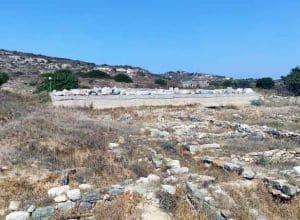
The foundations of the temple were uncovered under a building of the early Christian era, which reinforces the view that life in the settlement extended beyond late antiquity. Alasarna was a religious center alongside the Asklepiion of Kos even after the foundation of new Kos (336 BC).
Unfortunately, a large part of the temple was destroyed during the foundation of a hotel in the area. Three buildings have been excavated from the sanctuary to date:
Building A was uncovered in 1981 and contains the sanctuary of Apollo known from inscriptions in ancient Alasarna.
Building B which was probably an altar or sloping entrance to the temple.
Building C, which was uncovered in 1995 and may be a Late Classical or Early Hellenistic temple.
The temple was discovered after a rescue excavation carried out by the archaeologist of the KB’ Antiquities Administration of the Dodecanese, Ch. Kantzia, and since 1985.
The excavations are being continued by a group of teaching staff of the University of Athens in collaboration with groups of students.
Plane Tree of Hippocrates
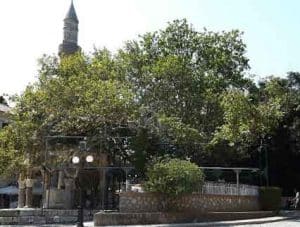
According to popular tradition, the plane tree was planted by Hippocrates about 2,400 years ago. Under his shadow, the great sage taught the science of Medicine to his students.
The plane tree has a circumference of 12 meters and a huge trunk that resembles a cave. Next to Platanos there are two fountains from the time of the Turkish occupation, while an inscription in Arabic states that their water is from the spring of Hippocrates.
The tree belongs to the “Oriental plane tree” species (Platanus orientalis L.) and its age is considered to exceed 2,300 years. The diameter of the trunk at its base is 4.70 meters and its circumference 10.50 meters.
Over the centuries, the wood of the trunk and old branches has been rotted by various fungi and wood-eating insects, resulting in a large hollow inside.
Roman Conservatory
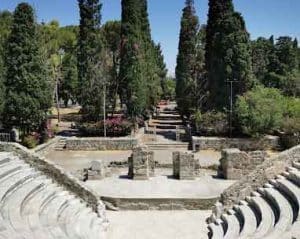
Although the conservatory was built to hold music competitions, it was also used at the same time as the seat of the Senate, which awarded honors to distinguished citizens of the island. The building was originally covered and its capacity is estimated at around 750 people.
Its hollow, oriented towards the north, was supported by vaulted structures, which were supported by cast masonry piers. It had fourteen rows of marble pews, nine of which have been restored, and was divided by a corridor into two diazomes, the lower of which was divided into stands with four steps.
Under the hollow, two semicircular galleries and a series of rooms were formed that served either as shops or as workshops. The stage had the unusual shape of an irregular pentagon and consisted of two parts, the foreground and the background, which communicated with each other by three entrances.
On either side of the stage there were two more doors leading to the passages. The orchestra was circular and its floor was decorated with marble. Two more mosaic floors adorned the corridors. They were found hidden around 18 marble statues, the most important of which is that of Hippocrates which is currently exhibited in the archaeological museum of Kos.
Cave of the White Stone
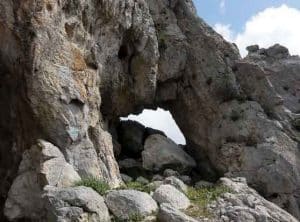
Its findings date from the Prehistoric to the Roman era. Inside it were found human fossils and many vases of various shapes and sizes with the predominant type being rounded arched handles.
On the contrary, weapons were rare, consisting of a few blades and sharp cores of obsidian stone (volcanic stone), which came from the island of Giali near Nisyros. The food remains found in the cave reveal a people devoted to grazing animals. The presence of pits filled with oval millstones was remarkable. The cave is considered one of the oldest monuments of the island.
Tomb of Harmylos
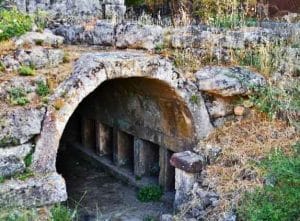
It is a semi-circular building with twelve symmetrical crypts, six on each side. The tomb dates back to the third century BC and is the hero of the corresponding time period. Formerly the facade of the tomb was covered by an Ionic portico made of white marble.
The specific pieces of marble together with a marble inscription thanks to which the age of the monument was determined were removed from the Tomb and are embedded in the church of Stavros, which is built directly above the tomb of Harmylos.
Mosque of Lozia
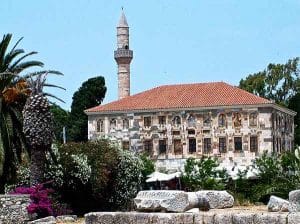
A tradition, saved by Zaraftis, states that the Mosque of Lozia was formerly the church of Agios Georgios. As the Lozia Mosque is only a few meters away from the basilica, perhaps this early Christian monument was also dedicated to Saint George.
For the construction of the Mosque, materials (mainly marble and stones) were used from the ruins of the three-aisled basilica of the port, as well as from the Baptistry of Agios Ioannis
Castle of Kefalos
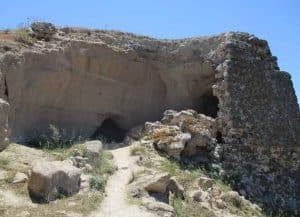
The castle dates back to the Byzantine era with the oldest reference to it dating back to 1271. In 1457 it was successfully used to repel the Turkish attack.
In 1493 and after the great earthquake that hit the island, it was almost completely destroyed and abandoned in 1505. Today, from the ruined castle the visitor can enjoy the panoramic view towards the gulf of Kefalos.
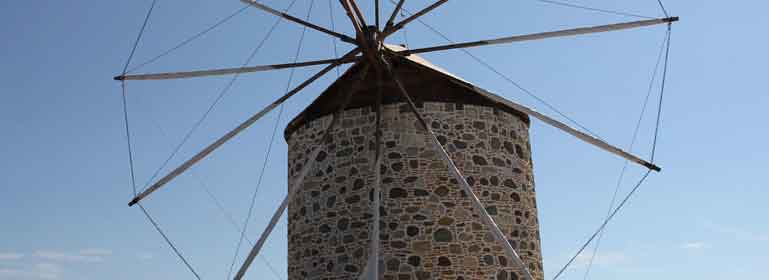
The traditional Mill of Antimachia
The traditional windmill for the production of flour is located in the square of the Community of Antimachia, next to the airport of Kos, at a distance of 22 kilometers from the city. In the same square, opposite the mill, there is also the folklore museum of Antimachia.