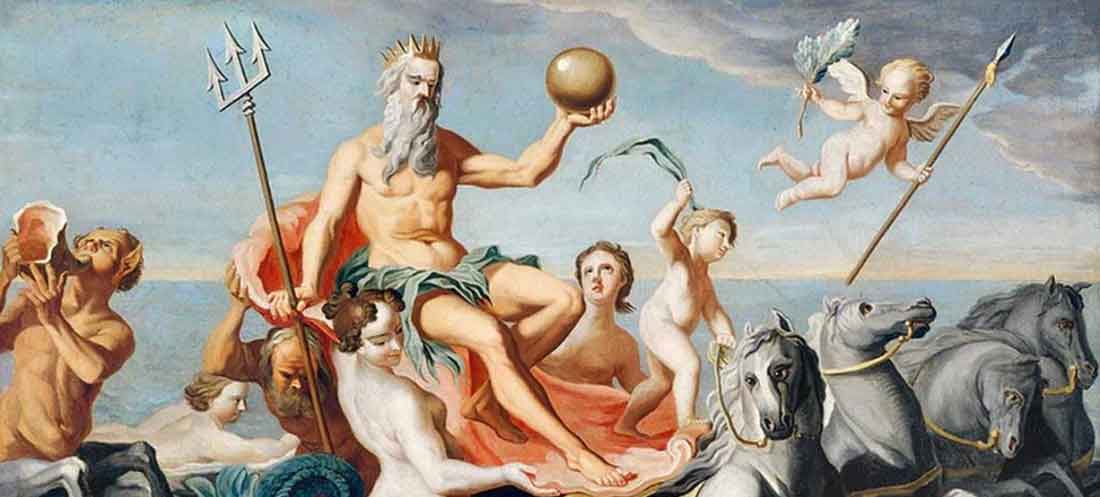
Zeus, the god who imposed order upon the Greek gods
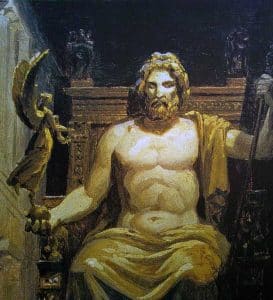
Zeus is the father of all the gods and humans, he is the most senior of the Olympian gods Master of the Heavens and Lord of the Universe. He was a third generation god. His grandmother was Gaea the first mother and he was the youngest child of the first race of deities, his parents being Cronus and Rhea.
He escaped the fate of his brothers and sisters of being swallowed by his father and was brought up in secret by the Nymph, Neda and the wives of the Corybands, Idaeon, Andron, dictaie and Melliai who were assisted by Adrastea and the goat Amalthea.
He led the younger generation of gods in the battles against the older race of Titans and afterwards the Giants and finally conquered the mighty serpent Typhon to win his position of King of all the Gods.
As king, Zeus created the world from scratch and after Prometheus’ attempt to help mankind, created a new race of humans that did not have the arrogance of the old human race but instead honoured their gods. He did this by sending a tremendous flood to the world with only Deucalion and Pyrrha surviving, then allowing them to create new humans from the rocks that they threw behind them.
He was married to Hera although he is known for his erotic philanderings, endless abductions and seductions of other women, appearing as either human or an animal to trick women to lay with him. He fathered many children, some godly but others heroic semi-gods. These included Athena, Aphrodite, Apollo, Artemis, Hermes, Persephone, Dionysus, Perseus, Hercules, Helen of Troy, Minos, the Muses, Ares, Hebeand and Hephaestus. By fathering a whole generation of gods and semi-divine heroes he usurped the powr of procreation from the Mother Goddess, Gaea.
As guarantor for the order and harmony of the world he would avenge and exterminate any god that went against him and upset this harmony. He was, however, also a protector and a fair god, who judged the actions of both gods and mortals with compassion. He protected the states and defended cities during wars. He granted freedom to those who were under his protection, protected the homes of humans, their peace and safeguarded the institution of marriage and friendship. Besides caring for families he protected the poor, strangers and refugees. He also was responsible for the climate and the changes in weather, sending rain to make the fields fertile.
His symbols of the eagle and the thunderbolt were linked to his powers with the eagle being the sacred bird which flies higher in the sky than any other bird and faster than everything but lightening. As well as these two symbols the oak tree is sacred to Zeus and in Zeus’ oracle in Dodona, Epirus, an oak tree was in the centre of the temple and the priests would divine the god’s pronouncements by interpreting the rustling of its leaves. Finally, the bull is a sacred animal that symbolizes Zeus. The god took the form of a white bull when he seduced the mortal Europa and in his seduction of Io, changed her into a heifer to conceal her from his jealous wife Hera.
As the sky god Zeus had easy access to the women of the world and took full advantage of it. Also, his power as a supreme god made him difficult to resist. Prior to his marrage to Hera he was married first to Metis, then Themis. He was interested in Demeter but she resisted him. His third wife was Mnemosyne.
Zeus was the most powerful god. He had overturned his father Cronus and seized power, and everything was ultimately in his hands. Zeus was a weather god, as well as the protector of the law, the state, the society, the city, the family and strangers. According to the myth, Zeus was the son of Cronus and Rea and born in Crete. He was the God of all gods and belonged to the second generation of the gods of Olympus. The story told is that before the birth of Zeus, Cronus was told by an oracle that one of his children would seize his power and so, rather then let this happen, he murdered all his children by eating them.
His wife, Rea, determined not to let this happen again on the birth of the baby Zeus, tricked Cronus by presenting him with a rock disguised as a newborn wrapped in swaddling clothes.
She then sought refuge in a cave on top of Mt. Dikti in Crete to give birth to her baby. Soon after this, the infant was moved to another lonely cave, Idaion Andro on Mt. Idi where he was raised by Nymphs and was suckled by a goat, Amalthia. In order that Cronus should be kept in ignorance about his secret son, the baby,s cries were drowned out by the giant gods, the kourites who created a cacophony by beating on their drums and singing loudly. When Zeus became an adult, he defeated his father and so became the king of the Gods.
All the other Olympian gods were either his siblings or his children. His wife was Hera but he had countless trysts with other goddesses as well as mortal women. One of these mortals was Europa whom he brought to Crete. The rock that tricked his father was put in Delphi to remind all mortals and gods of his magnificence.
Zeus main shrine was in Dodona, where it was believed one could hear the future being told by the wind blowing through the the leafs of the holy oak trees that grew there. In Olympia he was honoured every four years with the Olympic Games and Phidias statue of him there was considered one of the seven wonders of the ancient world.
The Nemean Games were also held in his honour. The birds, especially the eagle, were believed to be Zeus messengers and so his priests were careful to try and foretell the future through the birds flight. Mountains were often named after Zeus and still today there are mountains of Zeus all over Greece, for example on Crete and Naxos.
On Crete Zeus was especially worshipped since it was believed he grew up there, in hiding from his father who would have eaten him had he known of Zeus existence. On Crete his worshippers believed he was born there, and that he also died there. There was even a tomb there said to be his.
The name Zeus is believed to originate in the Sanskrit dyaus which means heaven. The ancient Greeks also called him Dias, and this name has through the Latin Deus become a common word for God in many languages.
Apart from being the highest God, Zeus was also a mischievous one. Constantly unfaithful to his jealous wife and sister Hera, Zeus had many children with other women, both mortal and immortal. With Hera he had Ares, Hebe, Hephaestus and Eileithyia.
In the guise of a swan he had seduced queen Leda of Sparta, and she bore Helen of Troy and Polydeukes as a result. As a bull he kidnapped the Phoenician princess Europa and she gave birth to Minos and Rhadamanthus..
With the goddess of memory Mnemosyne he became the father of the nine muses and with other goddesses and mortal women he had amongst others Apollo, Artemis, Dionysus and Heracles.
He was also the sole parent of Athena, whose remarkable birth had happened after Zeus had suffered a terrible headache. Hephaistus then hit him over the head with a sledgehammer, and out of Zeus head sprung the goddess, fully grown and in armor.
Not only women were his victims. The young Trojan prince Ganymedes was kidnapped by Zeus and taken to Mount Olympus, where he was made the servant of the gods.
Titanomachy and the new divine order
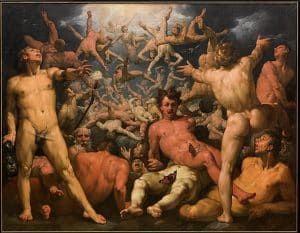
This battle symbolizes the predominance of order in a chaotic world. Saturn had not succeeded in fashioning a just world, but he let humanity suffer by allowing the violence of the powerful to prevail. Zeus, who cooperated with those who had been wronged by this wretched system and established a more rational system of power, symbolizes the power of reason that slowly begins to bring order to the chaotic world of emotions. Thus, for the first time, we have a distribution of responsibilities: Jupiter rules the sky, Poseidon the sea and Hades the Underworld. We still have co-operation between all twelve gods in matters concerning earth and men, which they discuss, argue and decide in councils called on Olympus.
The character of Zeus
But there were also many mortal women who bewitched the god with their beauty. Thus arose the demigod descendants of Zeus, such as Heracles, Perseus, Minos and dozens of others.
Jupiter may have loved amorous adventures, but he was not frivolous. In his palace he was serious and ready at any moment to restore order when it was disturbed by the actions of the other gods. Everyone resorts to him to settle their differences when the situation tends to get out of hand. When Aphrodite intervenes in the war between the Achaeans and the Trojans, Zeus reprimands her: “You have not been given the domain of warfare, my child. You deal with the works of marriage and the war will be taken care of by Ares and Athena”.
He himself, as leader of gods and men, is the only one of the Olympians who does not take sides in the Trojan War. In fact, when Hera put him to sleep so that he could favor the Achaeans unbroken, Zeus, waking up, threw a thunderbolt so that everyone would lose their courage and the balance of power would be restored.
At other times he is nervous and does not hesitate to blast those who do not keep their agreements or rebel against him. When he quarrels with Hera, threatens her with violence, when she overdoes it and when Prometheus steals his fire to give it to humans, Zeus punishes him very severely,
Zeus and Europa
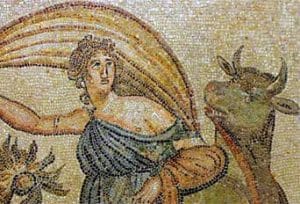
However, once she was astride he rushed into the sea and carried her off to Crete. As a gesture of his love for her he gave her a quiver of arrows that never failed in hitting their target, a golden dog as a guardian angel and the giant Talos to protect the island. It is claimed that the consummation of their love was in the area of Gortys, under a plane tree which then became evergreen.
Alternatively, it was at Diktaion Andron where their bridal bed was prepared by nymphs. They had three sons: Radamanthys, Sarpedon and Minos (who later became king). Unfortunately the faithless Zeus grew tired of her and passed her on to Asterionas, the king of Crete, who married her and took on her children. On her death, the Cretans paid tribute to her memory by naming one of the earth’s continents after her.
Places and Worship
The place mainly associated with the worship of Zeus is Dodona, where the ancient oracle of the god is located. Cult symbol of the oracle as early as the 2nd millennium BCE. it was the sacred oak. In Homer’s time, the priests of the temple, called Selloi, gave prophecies by observing the rustling of the leaves and branches of the sacred tree.
Later, during the classical period, the Selloi were replaced by female priestesses, the Peliades. In Dodona, the Vouleus (Counselor) Zeus had as his official companion Dione (the feminine form of his name), who belongs to the race of the Titans, and as an ancient deity, was probably worshiped there before Zeus. Aphrodite was, according to one version, a descendant of the couple.
A place of worship from archaic times was both the desert temple and oracle of Shiva in Egypt, where the god was worshiped as Ammon Zeus. In this oracle, in 332 BC, Alexander the Great is proclaimed “son of Ammon”. Sanctuaries of Ammon Zeus also existed in Thebes, Gytheion, Megalopolis and Oropos.
Most sanctuaries dedicated to Zeus are located on mountain tops. The best known is the one on Mount Lycaeus in Arcadia. There, in times of drought, the priests stirred the waters of Lake Agno with an oak branch and begged Lycaeus Zeus to send rain.
The most popular place of worship is certainly Olympia, where the famous temple of Olympian Zeus was built in the 5th century. This area has been a center of worship since Mycenaean times, when the inhabitants worshiped there Pelops, Rhea and Eileithyia.
It was called Altis, and it was a grove overgrown with oaks, olives, and pines, and full of altars, shrines, and statues. The cult of Zeus and Hera was introduced by the Dorians and had as its center a common temple for the divine couple.
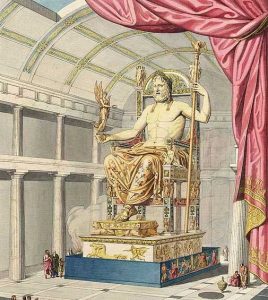
When the temple of Zeus was built, the oldest remained for the worship of Hera. From Olympus, the home of the new gods, the area was renamed Olympia and became famous for the Olympic Games that were established there in the 8th century BCE. In this temple was the now lost golden and ivory statue of Zeus, the work of the famous sculptor Phidias and one of the Seven Wonders of the ancient world.
The statue was 13 meters high, made of gold and ivory, and was placed behind an artificial pool of oil, in which it was reflected. The temple was set on fire and destroyed in 426 AD. during the period of Emperor Theodosius II, while the statue was dismembered and looted.
According to another version, the emperor moved it to Constantinople, where it remained for 60 years in a room with other ancient works of art and was completely destroyed by fire in 475. The abandoned temple was later looted by the Goths and a Christian temple was built in its place, the which was later destroyed by an earthquake. The area was covered by the bed of the river Alpheios and the ruins were discovered in 1875 by German archaeologists.
Finally, in Athens, they celebrated the Diipoleia (Zeus Polieus) in honor of the god on the 14th of Skiroforion (end of June). The ceremony had ancient roots and was as follows: In the temple of Zeus on the Acropolis, the priest placed offerings of wheat and barley on the altar, which were eaten by an ox. The priest would kill it with a pelecy and then disappear so as not to suffer the consequences of his act.
Since the other priests could not find him, they condemned the peleki and threw him into the sea. This action was aimed at demonstrating the sanctity of the ox, which was necessary for the cultivation of the land. For this reason, they embalmed his skin and tied it to a plow.
Other names of Zeus
In Rome Zeus was worshipped under the name Jupiter. He also had the following epithats:
Acraeus, Actaeus, Aeneius, Aethipos, Agamemnon, Agetor, Agoraeus, Ambulius, Ammon, Anchesmius, Apemius, Apesantius, Aphesius, Apomyius, Arbius, Areius, Astrapaeus, Atabyrius, Athous, Basileus, Bolaeus, Cappotas, Caraos, Carius, Cassius, Catharsius, Cenaeus, Charmon, Cithaeronius, Clarius, Coccygius, Conius, Cosmetas, Croceatas, Ctesius, Cynthius, Dictaeus, Dodonais, Eleutherius, Epacrius, Epidotes, Euanemus, Genethlius, Hecaleius, Hecatombaeus, Hetaareius, Homagyrius, Homarius, Homoloius, Horceius, Hyetius, Hymettus, Hypatus, Hypsistus, Icmaeus, Ithomatas, Laphystius, Larissaeus, Lecheates, Leucaeus, Lycaeus, Lycoreus, Maemactes, Mechaneus, Meilichius, Messapeus, Moiragetes, Morius, Nemeius, Ombrius, Olympius, Panhellenius, Parnethius, Phyxius, Phratrios, Plusius, Poleius, Scotitas, Semaleos, Soter, Teleius, Thaulius, Thenatias, Tropaeus