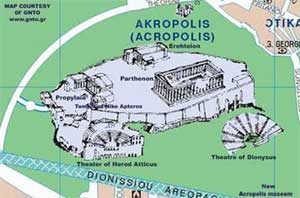
The Acropolis of Athens Greece
The word "Acropolis" means city by the edge, and there are many acropolises all over Greece. They were always situated on a high spot, and were often used as a place for shelter and defence against various enemies. The one in Athens is the best known of them all, and is therefore often referred to as "The Acropolis". Towering over the capital, its is a very impressive sight, and walking around on its grounds, it gives the visitor a feeling of awe and a true sense of the greatness of the ancient Greeks.
Mythology
The founder of Athens and Greek civilizations was king Cecrops,
according to mythology. He had been born out of the earth and was half man half
snake. He taught the people many crafts, as well as the burial customs, and
decided which god would protect the city.
There were two candidates: the goddess
Athena
and the god
Poseidon.
In order to prove their worth, and perhaps bribe the people, they each presented
the city with a gift. Poseidon struck his trident into the rock of the Acropolis,
and out sprang a well. The people ran to the well to drink its water, but had
to spit it out since the water was salt, Poseidon being a sea god. Then Athena
touched the ground, and an olive tree grew out. This proved to be a much more
useful present, so Cecrops decided that Athena would be the patron of the city
- thus giving it her name as well. The wooden statue of Athena which originally
stood on the Acro-polis was believed to have fallen out of the sky.
History of the Acropolis
 The Acropolis is believed to have been inhabited since at least the 7th Millennium BC. During
the Mycenaean civilization walls were built around it and there is evidence
that there was a Mycenaean palace here as well. The tomb of
Cecrops
also lie here, and the Athenians might have kept a snake here - symbolizing
their first king. There were also other tombs and temples here, all connected
to kings, heroes and gods that had to do with Athens.
The Acropolis is believed to have been inhabited since at least the 7th Millennium BC. During
the Mycenaean civilization walls were built around it and there is evidence
that there was a Mycenaean palace here as well. The tomb of
Cecrops
also lie here, and the Athenians might have kept a snake here - symbolizing
their first king. There were also other tombs and temples here, all connected
to kings, heroes and gods that had to do with Athens.
In the 6th century BC the Acropolis had changed quite significantly. It was
no longer a place for palaces, but had turned more into a sanctuary that anything
else. Every year a huge procession to the Acropolis took place, and the wooden
statue of Athena was dressed and sacrificed to. The Panathenean games were
also very important. The games included both athletic and musical competitions
and the winner would receive an amphora filled with olive oil - the olive
tree being the sacred tree of Athena.
During the Persian wars in the 5th century the Athenians started building
the Parthenon, but the Persians burnt the Acropolis and all focus was put
on the battles. It was during
Pericles
era, the so called Golden Age, when the Acropolis got the structure
we see today. Starting in the middle of the 5th century, the Parthenon, the
Propylaea and a huge bronze statue of Athena was made. It is said that Pericles
used unemployed Athenians for workers, and that it was thanks to this initiative,
every Athenian had food on his table. The Parthenon was made by the architects
Ictinus
and
Callicrates,
and the statue by
Phidias.Towards
the end of the 5th century the Erechteion was built, as well as the temple
of Athena Nike.
When the Romans conquered Greece in the 2nd century BC, many of the sanctuaries
were looted. Statues and other works of art were taken back to Rome from
Olympia
and Delphi for example,
but the Acropolis was pretty much left alone. Some of the emperors did make
a few additions, though. In the 2nd century AD
Herodes
Atticus had his great theatre built, and to this day, Athenians
are enjoying concerts and ballets here.
During the Middle Ages several of the temples on the Acropolis were converted
into Christian churches. Quite characteristic is the fact that the Parthenon,
which had been a temple to the virgin goddess Athena, now became a church
to the virgin saint Mary.
When the Turks came towards the end of the 16th century, they turned the Parthenon
into a mosque. Until the 17th century the temple was relatively unharmed,
but in 1687 the Venetians bombarded the Acropolis, and a projectile hit the
Parthenon, which the Turks used as a storage room for gunpowder. The temple
exploded and this is why the temple does not have a roof today.
In the beginning of the 19th century the Englishman lord Elgin was allowed
by the sultan to take with him various objects from the Acropolis. It was
now he took the famous Parthenon marbles, which until today is a matter of
controversy since they are housed in the British Museum despite the Greeks
plea to get them back.
Despite all that the Acropolis has been through, it is really the pollution
in modern Athens that is its worst enemy. The problem has been known for many
decades now, but still no real solution has been found.
Parthenon
The main building of this
period was the Parthenon, which we know, from its building records, to have
been under construction between 448 and 433 B.C. The colossal gold and ivory
statue within the temple was dedicated in 438 B.C. It follows that the
structure of temple must have been fairly complete by that date, the
subsequent five years being given to the finish of the surface and the
completion of the sculptural decoration. The architects were Ictinus and
Callicrates. The temple had a somewhat unusual plan, which it inherited from
the early temple of Athena. In addition to a main cells, opening to the
east, and containing the colossal statue of Athena, it had a square chamber
opening to the west, and shut off from the cells by a solid wall of marble.
This chamber was specifically called the Parthenon.
 When the temple was changed into a Christian church three doors, of which
traces may still be seen, were made through the wall. The western chamber
was used as a narthex, and an apse, of which also the traces may be seen on
the pavement, was built out at the east end. At the same time the inner
colonnade of the cells was removed, and smaller columns carrying a gallery
were substituted. In order to realize the original arrangement of the cells
we must ignore these later traces.
When the temple was changed into a Christian church three doors, of which
traces may still be seen, were made through the wall. The western chamber
was used as a narthex, and an apse, of which also the traces may be seen on
the pavement, was built out at the east end. At the same time the inner
colonnade of the cells was removed, and smaller columns carrying a gallery
were substituted. In order to realize the original arrangement of the cells
we must ignore these later traces.
There is a slightly raised stylobate on which the earlier columns were
placed along the north, south, and west sides. In the midst is a patch of
rough limestone. Over this was placed the pedestal on which stood the statue
of Athena; and in the middle of it is a rectangular hole in which was fixed
the wooden mast on which the framework of the colossal statue was supported.
The cella walls have to a great extent disappeared, but it is still possible
to appreciate the exquisite delicacy and finish of the architectural design
in the outer colonnade. It is possible, in looking along the steps, to
recognize the slight convex curve of the whole stylobate—probably an optical
correction, since a long, horizontal line with vertical columns resting
above it would otherwise give the illusion of sagging downward in the
middle. The refinements in the building lines of the Parthenon, first
accurately described by Dr Penrose, concern mainly the external appearance
of the temple. The curvature of the stylobate is perceptible only on that
part of it outside the cells. The interior floor of the cells is perfectly
flat and without any curvature. This can be verified by any visitor to the
building. The way in which the curvature of the stylobate along the
peristyle and steps was achieved is a matter of speculation. Probably the
stylobate was first built without curvature, and the curvature effected by
simple cutting down of the surface area to the required level at each end.
The temple was thus treated as sculpture. How carefully this curve was
designed and how it affected the form of the columns may be realized by
measuring the height of the lowest drums. This will be found to be in every
case greater on the outside than on the inside in a calculated gradation,
the difference being less as the middle of the side and front is approached.
It follows that no two drums on the same side are identical in measurement,
and that any attempt to replace fallen drums in position must necessarily be
preceded by an exact study of their dimensions. This has been done in the
recent reconstruction of the north colonnade, which is therefore much more
satisfactory in effect than the unsightly restoration made in the middle of
last century and recently demolished. Again, if one looks along the
colonnade on either side of the temple the open space framed between the two
extreme columns of the front and back shows clearly the delicately curved
entasis of those columns. It has been said that there is not a straight line
in the building and this is true except of the interior surface of the
stylobate.
The Parthenon appears to have remained practically intact until about the
fifth century A.D. The alterations made when it was changed into a Christian
church have already been noted. To the same time belong the frescoes of
Christian saints which may still be traced on the inner walls of the cella.
A further change into a mosque, during the Turkish domination, seems not to
have led to any considerable modifications in the structure of the building,
except that a minaret was constructed in the south-west corner, its basis
filling part of the opisthodomos, and its tapering point rising high above
the roof.
At this time the sculpture on the temple appears to have been almost
complete, except the central group of the eastern pediment, which was
probably destroyed when the Parthenon was changed into a church. This was
the state of the temple in 1674, when Carrey made his drawings of the
sculptures. The disaster mainly instrumental in reducing it to its present
appearance occurred during the attack of the Venetians against the Turks in
1687. The Venetian artillery bombarding the Turks in the Acropolis exploded
a powder magazine placed in the cella. Yet further destruction was caused by
an unsuccessful attempt to remove the chariot and horses of Athena from the
western pediment. Athens was soon after recaptured by the Turks, and a small
mosque was built within the ruined walls of the Parthenon. In this state it
remained for about two centuries, during which many travellers visited and
described Athens.
 Meanwhile the buildings in Athens were continually liable to damage, from
neglect or from weather, or from wilful destruction. The Greeks had as yet
no power, even if they had the desire, to protect them. Hence arose the plan
of removing at least some of the sculpture to a place where it would be both
safe and accessible. It was above all the French, represented by the Comte
de Choiseul-Gouffier and Fauvel, and Lord Elgin, the British Ambassador to
the Porte, who made this attempt.
Meanwhile the buildings in Athens were continually liable to damage, from
neglect or from weather, or from wilful destruction. The Greeks had as yet
no power, even if they had the desire, to protect them. Hence arose the plan
of removing at least some of the sculpture to a place where it would be both
safe and accessible. It was above all the French, represented by the Comte
de Choiseul-Gouffier and Fauvel, and Lord Elgin, the British Ambassador to
the Porte, who made this attempt.
The subsequent history of the Elgin Marbles does not here concern us. But it
is to be noted that even if they were now returned to Athens, as some have
suggested, they could not be replaced upon the building without its cοmplete
reconstruction, but would in all probability be placed in a museum where
they would be less accessible than they are at present.
When the independence of Greece was attained in 1830 the Acropolis was
cleared as far as possible of the remains of post-classical times, but no
attempt at reconstruction was made for some time. About the middle of the
nineteenth century some of the columns of the northern peristyle were
re-erected from fallen drums; but these, as may be seen by studying old
photographs of the Parthenon taken before 1930, were set up without
sufficient study of the problem, and were very unsightly, being patched with
brick and other materials. The first thing to be done in the modern
reconstruction was to pull down these columns, and to make an exact study of
the measurements of the external drums on this side, no two of which are
identical, owing to their positions on the slightly convex stylobate. The
drums were then replaced in their proper positions, and patched, so far as
was necessary, by stucco tinted so as not to make a glaring contrast with
the original marble.
All the northern columns, with the architrave resting upon them, have now
been reconstructed, but the process may probably go no further, at least for
the present. To restore the whole temple to the condition it was in at the
time of Pericles is obviously impracticable, even if it were desirable. The
only sculptures left upon the building are two figures, Cecrops and his
daughter, on the western pediment some remains of horses heads from the
chariots of the Sun and Moon; the much-defaced metopes of the eastern and
western ends, and two or three on the north and south sides adjoining the
western end; and the frieze at the west end and the adjoining part of the
north side. These metopes and the frieze are particularly instructive, since
it is possible to see them in their original position and setting. Some
other portions of the sculpture of the Parthenon are to be seen in the
Acropolis Museum. The metope at the south-west corner is happily well
preserved, and therefore, remaining in its architectural frame, gives a good
notion of the original effect. Being sheltered by the projecting cornice, it
was left in position when the other metopes were removed.
Popylaea
The latest building of the time of Pericles was the great Propylaia, or gate-house, at the entrance to the Acropolis. It consisted of a wall pierced by five doors; this had on a front facing the Acropolis a portico of six Doric columns. Outside it was a court with a roadway through it bordered by two rows of Ionic columns, and outside this another Doric portico of six columns facing outward. On either side this last portico was flanked by a wing which projected beyond the main structure. The plan is not quite symmetrical, because the south wing, where it adjoined the little precinct of the temple of Victory, is curtailed, and there are also indications that the original plan of the Prορylaia included two porticoes on the side facing the Acropolis, and flanking the great inner portico. These indications have been studied by Professor Dorpfeld, who has inferred from them the original design of the architect Mnesicles. Why this plan was never carried out is a matter for conjecture. It may have been partly due to the beginning of the Peloponnesian War but it is also to be noted that the original plan, if carried out, would have involved cutting away a great part of the rock surface of the early sacred precinct of Artemis Brauronia. It is therefore probable that religious conservatism is, at least in part, the cause of the curtailment, and may also account for the abridged form in which the south wing had to be left. In any case, the building was never completely finished, as may be seen from the rough bosses left on many of the stones and the absence of the final dressing of the surface in many places. The original blocks, which had fallen from the building, have now been replaced, especially on the inner portico, and the whole has regained much of its original effect, as seen from the Acropolis.
Erehtheum
 The other conspicuous building on the Acropolis, which may have been
included in the plans of Pericles and Phidias, was not built until after
their time. The Erechtheum was probably begun about 420 B.C., when there
was an interval of peace in the Peloponnesian War but it remained
unfinished until 409 B.C., when a commission was appointed to make a
survey of the building and to supervise its completion. The temple was
of a peculiar plan, owing probably to the fact that it took the place of
earlier shrines on the same site, and had to include certain sacred
objects.
The other conspicuous building on the Acropolis, which may have been
included in the plans of Pericles and Phidias, was not built until after
their time. The Erechtheum was probably begun about 420 B.C., when there
was an interval of peace in the Peloponnesian War but it remained
unfinished until 409 B.C., when a commission was appointed to make a
survey of the building and to supervise its completion. The temple was
of a peculiar plan, owing probably to the fact that it took the place of
earlier shrines on the same site, and had to include certain sacred
objects.
The eastern portion formed a small temple of the usual type, dedicated
to Athena Pallas. The western end had projecting porches both to the
north and to the south, and was at a lower level than the eastern
portion. In architectural form and decoration the Erechtheum is a
perfect gem of the richest Ionic style. The columns have capitals deeply
cut and delicately profiled in the volutes, and bases either reeded or
ornamented with a fine plait pattern; and both the columns and the walls
are surmounted by a band of beautifully carved honeysuckle pattern.
The northern porch, standing in front of a richly ornamented door,
probably covered the place on which the marks of the trident of Poseidon
were made when he struck the rock in his contest with Athena for the
land of Attica. These so-called `trident marks' were no doubt identified
as such in later antiquity. But in all probability they mark a place on
the rock where a lightning stroke had struck. This is suggested by the
way in which the rock so struck was left uncovered and a corresponding
opening in the superimposed roof of the porch left open to the sky.
If the marks were originally considered as trident marks these provisions to maintain them open to the sky would not have been taken in the fifth century. Athena at the same time produced the sacred olive-tree, which was preserved in the Pandroseum, just outside the west end of the Erechtheum. The southern porch is famous for the six maidens—commonly called Caryatides—who serve in the place of columns to support the roof; one of these was removed by Lord Elgin's workmen, and is now in the British Museum, its place being taken by a cement cast. This procedure of Lord Elgin has perhaps been more severely criticized than any other of his actions. But it is to be noted that the building suffered very considerable damage both during the War of Independence and later, and there was some risk of its total destruction. The Erechtheum has now, however, been reconstructed as far as possible out of the original materials, and gives a much better notion of its appearance when perfect than would be gathered from pictures made before the last few years.
Acropolis Museum
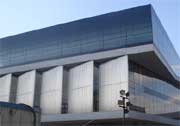
The new Acropolis museum is situated under the south slope of the
Acropolis in Dionyssiou Areopagitou street .The museum was given
to the public in 2008 .
Here, you will see various artworks from the temples and the other buildings
it has as well the statues of the Caryatides and parts of the
Parthenon Frieze.
It should be noted that photography is not allowed and you are
also not allowed to pose with the various objects. The Acropolis
Museum has been specially built to hold all the sculptures found
in the excavations upon the Acropolis.
The museum contain the early architectural sculptures in Piraic
limestone (poros) which once adorned the ancient temple of
Athena and other early buildings. They were for the most part
found buried in the earth south of the great basis on which the
Parthenon now stands, and must probably, from the remarkable
preservation of their colouring, have been buried soon after
their erection. Some of them represent the exploits of Heracles.
 One of the earliest, in low relief, represents the hero in
combat with the Hydra, whose snaky coils fill one end of the
pediment, the other end being occupied by the chariot of
Heracles and a gigantic crab. The most conspicuous of the
pedimental groups represents Heracles wrestling with Triton, the
"Old Man of the Sea", the other half of it is occupied by a
strange three-bodied monster and the three intertwined tails of
this balance the fishlike tail of Triton as a filling for the
narrowing space of the gable. This group probably ornamented one
end of the early temple of Athena.
One of the earliest, in low relief, represents the hero in
combat with the Hydra, whose snaky coils fill one end of the
pediment, the other end being occupied by the chariot of
Heracles and a gigantic crab. The most conspicuous of the
pedimental groups represents Heracles wrestling with Triton, the
"Old Man of the Sea", the other half of it is occupied by a
strange three-bodied monster and the three intertwined tails of
this balance the fishlike tail of Triton as a filling for the
narrowing space of the gable. This group probably ornamented one
end of the early temple of Athena.
Another fine architectural pediment group is that representing
the introduction of Heracles to the assembly of the gods on
Olympus. It shows Hera and Zeus seated and Heracles in the
corner. A further pedimental sculpture is that which shows the
scene of the slaughter of Troilus by Achilles. A fountain-house
fills the centre, with a maiden outside it. Parts of Troilus and
a tree are visible at the side. Another great group shows two
lions tearing a bull. All these sculptures show the remains of
rich colouring, and their effect when placed on the buildings to
which they belonged must have been very impressive.
The colossal figures in Parian marble which were placed in the
pediment over the colonnade added to the early temple of Athena
in the time of Pisistratus. In the centre was a figure of Athena
striking with her spear a giant prostrate at her feet. Portions
of two more giants are to be seen; the whole composition must
have contained other gods and giants, and must have been a fine
example of the bold and severe style of archaic Attic work.
The series of female statues which constitutes the chief
treasure of the Acropolis excavations, most of them were found
carefully buried in the space just to the north of the
Erechtheum. They must have been thrown down by the Persians when
they sacked Athens, and buried by the Athenians when they
returned to the ruins of their city; and therefore they offer us
characteristic examples of the art of sculpture as it was
practised at Athens in the years preceding 480 B.C. We do not
know whom these statues were intended to represent: their
official name seems to have been "Maidens" (Korai), and it
appears to have been customary to dedicate such statues to
Athena, perhaps as a memorial of some service.
At first sight they seem much alike, as repetitions of the same
type, but on closer study we find a great degree of
individuality, and also rapid artistic progress from the earlier
to the later. Some of the simplest and severest are like the
Athena from the great marble pediment, and show us Attic art in
its independent period. But a strong influence from the
islands—probably from the Cyclades introduced a delicacy and
grace which in some cases amounts to affectation, and is
enhanced by the full and rich Ionian draperies of which the
sculptor had evidently made a careful study. Then, again, in the
later examples we find a stronger and simpler style. This may be
due partly to an Athenian reaction against the island work,
partly to the influence of the Doric schools of the Peloponnese.
These marble sculptures, like the earlier ones in porous stone,
have their original colouring to a great extent preserved. But
while the poros statues were mostly covered with an opaque coat
of paint, the marble statues show its use with much greater
discretion. The beautiful texture and surface of the white
marble was preserved for the nude parts of female figures, and
also for the broader stretches of drapery, and the colour was
only used to render details such as hair, eyes, and lips, and to
ornament the bottom and someώhat scattered patterns on the
drapery. Used in this way, the colour by no means conceals the
texture and effect of the marble, but enhances them by contrast
with the coloured details. The richness of effect thus gained
must be seen to be appreciated.
In addition to these early works the Acropolis Museum also
contains such portions of the sculpture of the Parthenon as were
neither carried off by Lord Elgin nor left in situ upon the
temple. Among them the finest are some slabs of the frieze,
especially one with Athenian youths leading cows for sacrifice,
and another, in remarkable preservation, containing three
figures from the group of gods in the east frieze. Also, in the
east room, on the right of the door, there are the remains of
the sculpture of the balustrade of the temple of the Wingless
Victory. They consist of figures of winged Victories erecting
trophies or otherwise employed in the service of Athena, among
them the famous Victory tying her sandal, and two Victories
mastering a restive cow. These are perhaps the most perfect
examples known of clinging and floating draperies revealing and
contrasting with an extraordinarily beautiful type of figure.
The date of them is probably about the close of the fifth
century B.C.
They have been frequently imitated both in later Greek work and
in Greco-Roman, whence their influence passed on to the
sculptors of the Renaissance.
Getting to Acropolis
The Acropolis is pretty much situated in the middle of the city and is hard to miss. The best way perhaps is to walk there either from Syntagma, Plaka or Monastiraki, from Monastiraki, at the end of Adrianou street, you can walk up to the Acropolis through the Agora or going up the steps from Dioskouron street. The easiest way is to take the Metro of Athens and get off to the Acropolis station, at the exit towards Dionysiou Areopagitou located the entrance of the new Acropolis museum and and after 3 minutes walk next to the Odeion of Herodes Atticus is the entrance to the Acropolis. There are also organised tours, where a visit to the Acropolis is the main attraction
Map of the Acropolis