
The war of Independence of Greece and the Revolution of 1821
No doubt the Greeks had wanted their freedom from the very beginning of the Ottoman rule, but in the 18th century the idea of a free Greece grew into an organized plan. With Russian help a revolt started in 1770, which failed.
Inspired by the French revolution and the heroic poems (thourios) of Rigas Feraios, the Greeks did not give up, and the secret society Philiki Etairia (“Friendly Society”) was founded in 1814 in Odessa of Russia by Nikolaos Skoufas, Emmanuel Xanthos and Antonios Tsakalof. Weapons and funds were collected, and help was sent from Greeks in exile as well as other countries on the Balkan and the Mediterranean sea.

Timeline of the revolution of 1821
A. The revolution in Moldavia.
On February 22, 1821, Alexandros Ypsilantis crossed the river Pruthos, marking the beginning of the revolution. In Iasion, Ypsilantis officially declared the revolution and Georgakis Olympios hurried to join him (February 26). In the ensuing fundraiser, an amount of one million groschen was raised, while Kantakouzenos took over the leadership of the “Sacred Band”, which consisted of 500 young students. On March 17, Ypsilantis raised the Greek flag in the capital of Wallachia, Bucharest. Ιn Galatsi, the Greeks led by Karpenisiotis clashed for the first time with the Turks and managed to break their lines. In Dragatsani, however, the Sacred Band crashed and in the monastery of Sekos, Georgakis Olympios and his comrades-in-arms were blown up together with the gunpowder depot so that they would not be surrender. The first attempt of the fighters in Moldavia was short and unfortunate. Nevertheless, it facilitated and prepared the outbreak of the revolution in Moria (Peloponesse) , Roumeli, Epirus, Macedonia, Thessaly and the islands.
B. The revolution in the mainland of Greece.
After the failure of Ypsilantis, the Peloponnese was the first to revolt. The conquest of Kalamata was achieved on March 22, 1821, but the official start of the struggle is considered to be March 25 1821, the day when, according to tradition, in the monastery of Agia Lavra, the bishop of Palaion Patron Germanos raised the flag of the Revolution, which was spread like fire all over Greece.
On March 26, Spetses revolted, on the 27th Salona with Panourgias, on the 28th the Municipality of Kaltsas occupied Lidoriki, on the 29th Alexios Diakos declare the revolution in Livadia, on the 31st Atalanti revolted, on the 1st of April Thebes, on the 8th Lamia. The Turks became seriously concerned and wanting to terrorize the rebellious Greeks, hanged Patriarch Gregory the 5th (April 10). On the same day, however, the island of Psara revolted and at the 15th the Greeks defeated the Turks at Levidi.
Hydra declared the revolution on April the 16th and on the 24th Diakos martyred in Lamia, on the 25th of the same month, Athens was occupied and the Turks were under siege on the Acropolis, on the 7th of May Anthimos Gazis declared the revolution in Magnesia and on the 8th Odysseas Androutsos fought in Gravia with a hundred fighters, who blocked the way of 8,000 soldiers of Mehmet and Omer Vryonis.
The revolution spread to Macedonia and on May 16, Halkidiki and Mount Athos revolted, led by Emmanuel Pappas from Serres. On May 20, Messolonghi revolted, while in the Peloponnese the siege of Tripolitsa began. On the 23rd of May the Greeks had the first “in line” victory in Valtetsi with Nikitaras (nicknaamed the Turk slaughter), on the 26th the elite of Peloponesse formed the “Peloponnesian Senate”, the first beginning of the revolted Greece, and on the 28th the revolutionaries entered Agrinion.
At the same time in the Aegean the fleets of the Greek islands started military action, in which Hydra , Spetses, Crete, Samos, Mykonos, Kalymnos, Kasos and other islands took part. Among them the famous fleet owners and captains, Papanikolis, Manto Mavrogenous, Bouboulina, Kanaris, Miaoulis and others were engaged.
Finally, on September 23, the Greeks occupied Tripoli and thus the revolution was consolidated, while on December 30, the First National Assembly of the Greeks convened in Epidaurus under the chairmanship of Mavrokordatos.
The chronicle of the Greek revolution.
During the first three years of the Revolution, significant successes were achieved, but the civil war that broke out between the chiefs and the Kotzabasides (a rich oligarchy, who exercised considerable influence and held posts in the Turkish administration) for the leadership of the revolution, caused very serious problems and brought the struggle to a tipping point. The absence of a leading figure who would be able to reconcile the opposing sides is obvious.
Despite the arrival of Dimitrios Ypsilantis in the Peloponnese in 1821 as the supreme representative of the Friendly Society (Filiki Etairia) , they were created by the Kotzambasides with the support of the Phanariotes Alexandros Mavrokordatos and Theodoros Negrios. to be imposed on naughty soldiers, ignorant of any form of organization and discipline, commanded by leaders with a strong sense of localism and selfishness. At the same time, European diplomacy is hostile to the Revolution, as the Holy Alliance fears the spread of revolutionary ideas throughout Europe.
The war during 1822

On January 14, Acrocorinth was conquered, on February 19, Naoussa revolted with Karatasos, on January 20, Admiral Andreas Miaoulis defeated the Turkish fleet in the Gulf of Patras, on March 18, Lycurgus Logothetis with 2,000 Samians captured Chios, but 30,000 men, who carried out the terrible massacre of Chios. Kanaris avenged the massacre by blowing up the Turkish flagship (June 7th). Khurshid Pasha besieged the Souliotes, to whose help Mavrokordatos and Mr. Mavromichalis rush. In Kompoti the Greeks and many philhellenes win, but the great destruction of Peta follows.
Mahmut Pasha Dramalis invades the Peloponnese, but on July 26 his army suffered great destruction from Kolokotronis in Dervenakia, where Nikitaras, for the second time, became a Turkophagous. From September 8-11, the Greek fleet collided in Nafplio with the Turkish, which was forced to take refuge in Souda. On September 24, the Turks landed in Crete to bend its resistance. On October 25, Kioutachis and Vryonis camped outside Messolonghi. On the 27th, Kanaris set fire to Tenedos, the sub-flagship of the Turkish fleet, which took refuge in the Hellespont, and Staikos Stamatopoulos captured the invincible Palamidi. On December 31, the Turks were forced to end the siege of Messolonghi.
The battles in 1823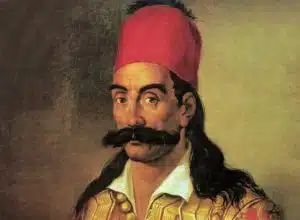 On January 15, Karaiskakis drove the Turks out of Agrafa. On March 29, the Second National Assembly met in Argos. In May, Krieziotis defeated the Turks in Karystos, M. Botsaris in Vonitsa and Karatasos in Trikeri. On August 21, Markos Botsaris with 350 Souliotes defeated Mustai in Karpenisi, but he was also killed. However, the civil war continues, Alexandros Mavrokordatos is appointed president of the Executive and the rank of general is removed from Th. Kolokotronis, when two governments are formed by G. Kountouriotis and Th. Kolokotronis. At the same time, the change of government in England brings to the position of Foreign Minister the philhellene G. Canning (1822), who decides to support the Greek revolution, in order to take advantage of the collapse of the Ottoman Empire for the benefit of England. The change in the attitude of English politics motivates the tsar to take initiatives and submit to the Gate a memorandum proposing the creation of three autonomous Greek provinces under the sovereignty of the sultan. This plan, however, is rejected both by the Gate and the warring Greeks, as well as by the Greeks.
The war during 1824.
 On January 5, 1824, the arrival of Lord Byron in Messolonghi enlivened the fighters and aroused pan-European interest, but on April 7, Byron died in the same city. On June 7, the Egyptians, called for reinforcements by the Turks, destroyed Kassos.
On June 9, the heroic island of Psara was captured. Towards the end of July Sachtouris, Kanaris, Matrozos, Vatikiotis and Rafalias achieved significant success at sea and on August 29
in a new glorious success to the Elder.
On September 22, two enemy warships were set on fire near Chios and on November 1, after a fierce clash near Heraklion, Ibrahim’s fleet was forced to retreat.
1825.
On February 12, Ibrahim landed in Methoni and on April 16, in Schinolakka, Messinia, Karatasos and his Macedonians successfully confronted the Egyptians. In Sfaktiria, however, the Egyptians won and Tsamados, Sachinis, Anagnostaras and the philhellene Santaroza were killed. On April 23, the Second Siege of Messolonghi began. On May 20, Papaflessas was heroically killed in Maniaki. Pressed by the popular outcry and panicked by Ibrahim’s advance, the government is finally persuaded to release the captive chiefs and reassigns Kolokotronis the military leadership of the Struggle. At the Mills on May 13, Makrygiannis and K. Mavromichalis stopped Ibrahim, who was on his way to Nafplio. In December, Ibrahim went to Messolonghi to take part in the siege.
The battle of Messolonghi 1826
On April 10, the exit of Messolonghi takes place. The besieged, excluded for months by land and sea without the possibility of refueling by the Greek fleet and decimated by hunger and disease, attempt to leave Messolonghi. But the plan of the besieged had been betrayed to the Turks and the heroic exit ended in a massacre. Those of the Messolonghi who manage to survive take refuge in the Ionian islands, while the heroism of the “Free Besieged” (according to Dionysios Solomos, the National poet of Greece) causes once again the rise of the philhellenic movement in Europe.
On June 22 and 24, the people of Mani repel the Ottomans in Verga. On the 27th and 28th the Egyptians are defeated at Maniakova and Polytsaravo. On August 3, Kioutachis captured Athens and besieged the Acropolis. Karaiskakis and Favieros encamped in Chaidari in Athens and on August the 8th clashed with the Turks. On September 3, the Greeks acquired the first warship “Karteria” and in December the frigate “Hellas”.
On the Acropolis, Gouras was killed and Krieziotis was appointed guard, who climbed the Holy Rock with 500 warriors. In Arachova, Karaiskakis defeated the Ottomans (November 18-23) and on December 1, Favieros ascended the Acropolis with 500 men. In the meantime, after the 3rd National Assembly of Epidaurus, the Russian, English and French parties are formed in Greece, whose followers are looking forward to the help of the respective foreign forces, while the 4th National Assembly of Troizina elects Ioannis Kapos as governor, appoints the Englishman George as commander-in-chief and the Englishman Cochran as commander-in-chief.